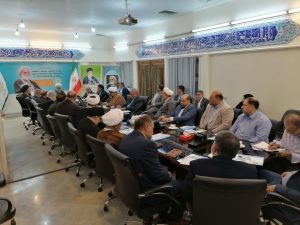
Tehran Seminar Commemorates Scholar and Jurist Ayatollah Abulghasem Khazali
TEHRAN — A decade after his passing, the scholarly contributions and public service of Ayatollah Abulghasem Khazali were examined in a specialized seminar that drew seminary and university professors, researchers, and intellectuals to analyze the late jurist’s intellectual legacy and his work as founding Secretary-General of the Ghadir International Foundation.
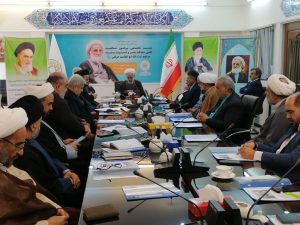 The seminar, held Tuesday at the Ghadir Martyrs Building, moved beyond conventional memorial observances to undertake a systematic examination of Ayatollah Khazali’s life and thought. The gathering, which took place on September 16, 2025, corresponding to 23 Rabi’ al-Awwal 1447 in the Islamic calendar, adopted what organizers described as an “explanatory and cognitive approach” aimed at analyzing the “Model of Mujahid Living” evident in the late scholar’s career.
Speakers at the seminar detailed multiple dimensions of Ayatollah Khazali’s work, emphasizing what they characterized as his “insightful struggle”—referring to his relentless steadfastness in protecting the concept of Wilayah, or guardianship, and defending the ideals of the Islamic Revolution. Participants explored his reputation for scientific authority, particularly his extraordinary mastery of Quranic interpretation and his profound knowledge of Nahj al-Balagha, the collected sermons and letters attributed to Imam Ali. His dedication to disseminating what the tradition calls the pure teachings of the Ahl al-Bayt, the household of the Prophet Muhammad, formed a central theme throughout the presentations.
The seminar also examined Ayatollah Khazali’s structural contributions to Iranian governance, including his service on influential bodies such as the Guardian Council and the Assembly of Experts. Speakers characterized his approach to these roles as marked by what they termed a “fair and trans-factional perspective.”

A significant portion of the seminar focused on the Ghadir International Foundation itself, the institution Ayatollah Khazali established with the explicit aim of “institutionalizing the culture of Ghadir on an international level.” According to seminar participants, the foundation’s mission centers on presenting the event of Ghadir not merely as a historical milestone but as what they describe as a “doctrine for the just management of human society.”
The foundation’s approach, as outlined during the seminar, rests on three core pillars. First, it seeks to present Ghadir as a governance model with contemporary relevance. Second, it adopts what is known as a Taqrib approach—an inclusive methodology that promotes the virtues of Imam Ali as common ground and a focal point for convergence among various Islamic schools of thought. Third, it engages in scientific and cultural content production, organizing global congresses, supporting high-level academic theses, and publishing specialized books on what it terms the Alawite lifestyle and teachings.
Throughout his life, Ayatollah Khazali viewed the Ghadir Foundation as a platform to, in the words of seminar participants, “weave the message of Alawite justice into the fabric of society.” The foundation’s work spans scholarly research, cultural production, and international programming, all directed toward what its mission statement describes as globalizing the concepts associated with Ghadir.
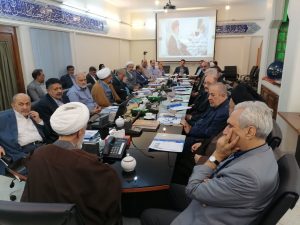
Participants in the September 16th seminar emphasized the importance of continuing what they called “the path of this divine scholar” in strengthening the bond between society and the teachings of Ghadir while safeguarding the principles of Wilayah. The gathering reflected ongoing efforts within Iranian scholarly circles to ensure that Ayatollah Khazali’s vision for the Ghadir Foundation remains an active intellectual and institutional project rather than simply a historical legacy.
The seminar’s analytical focus suggested an attempt to position the late jurist’s work as a continuing framework for approaching questions of Islamic governance, scholarship, and unity across denominational lines.