AL-BUNŪK: AL-ASHUM WA-AL-SANADĀT AL-MUTADĀWALA FĪ AL-ASWĀQ AL-MĀLIYYA (AL-BŪRṢĀT) BI-MUKHTALIF ANWĀʿIHĀ MIN WIJHAT AL-NAẒAR AL-SHARʿIYYA [BANKS, SHARES, AND BONDS TRADED IN FINANCIAL MARKETS (STOCK EXCHANGES) IN THEIR VARIOUS FORMS FROM THE PERSPECTIVE OF ISLAMIC LAW]. By Muhammad Ishaq al-Fayyad. Najaf, Iraq: Dār al-Badhra, 2011. Pp. 254. 5th ed.
Introduction
Modern financial institutions and transactions have raised important questions for Islamic jurisprudence, particularly concerning banking, interest, shares, bonds, financial markets, credit cards, options, and futures. In response to these developments, contemporary Muslim jurists have sought to examine new financial practices in accordance with the established principles of Islamic law. Al-Bunūk by Ayatollah Muhammad Ishaq al-Fayyad is an important work in this field, particularly within the contemporary Shi’i jurisprudential tradition of Najaf.
Muhammad Ishaq al-Fayyad is one of the prominent contemporary Shi’i jurists associated with the scholarly tradition of Najaf. His jurisprudential works address a wide range of contemporary issues and seek to apply established principles of Shi’i jurisprudence to changing social, legal, and economic circumstances. The importance of Al-Bunūk lies in its examination of financial institutions and instruments that developed largely in the modern period and therefore require detailed jurisprudential consideration. The work is particularly relevant to researchers in Islamic jurisprudence, Islamic economics, Islamic finance, banking, financial law, and contemporary Shi’i studies.

Summary and Content Overview
The book begins with an examination of banks and interest-based transactions. One of the important questions addressed by the author concerns the jurisprudential nature of money deposited in banks: al-Fayyad examines whether a bank deposit should be regarded as a wadiʿah (deposit) or qard (loan), a distinction that matters because the legal consequences of these two contracts differ, particularly regarding ownership, liability, and the use of deposited funds. The author also discusses deposits in Islamic banks and the legal status of deposits held in government banks and institutions.
The author then considers alternatives to conventional, interest-based banking. The discussion is not limited to explaining the prohibition of riba (interest/usury); rather, it examines the contractual arrangements through which banking activities may be conducted in accordance with Islamic law—addressing how modern banking and financial intermediation can operate while remaining consistent with Islamic law.
A significant part of the book deals with banking services and their jurisprudential status in Islam, including non-performing debts, insurance, cheque collection, domestic and international transfers, commercial bill discounting, bank guarantees, credit facilities, documentary credits, personal credit, storage of goods, loans and financing, foreign-exchange transactions, and bank cheques. Through this discussion, al-Fayyad demonstrates that modern banks perform many functions beyond lending money, also facilitating payments, trade, guarantees, financing, and foreign exchange.
The book also examines credit cards and the contractual relationships involved in their use, considering different forms of credit cards and the obligations of the parties involved—the cardholder, issuing institution, and merchant. This discussion is significant because modern payment systems involve several contractual relationships and cannot always be explained through the traditional relationship between lender and borrower.
Another important section concerns shares and bonds. The author discusses the nature of shares, joint-stock companies, ownership rights, and share trading in financial markets, and also examines participation in companies operating in non-Muslim countries and the jurisprudential status of their shares, extending Islamic jurisprudential analysis to modern corporate structures and capital markets.

Subsequently, the book addresses financial markets and stock exchanges. Al-Fayyad discusses organized financial markets and the different types of assets traded in them, including gold, silver, paper currency, commodities, and food products, demonstrating an effort to understand financial transactions within their institutional context rather than examining individual contracts in isolation.
The discussion then turns to options contracts, including call options, put options, and those involving foreign currencies. The author examines the nature of these instruments and considers jurisprudential concerns relating to speculation, gharar (excessive uncertainty), and maysir (gambling), aiming to determine the legal character of these contracts and whether their structures can be accepted within Islamic jurisprudence.
The final major subject is futures contracts. Al-Fayyad explains aspects of futures markets, including standardized contracts, brokers, guarantees, margins, clearing arrangements, and settlement procedures, then considers jurisprudential questions concerning ownership, the sale of property before possession, and the postponement of payment and delivery—illustrating the difficulty of applying traditional legal categories to complex financial instruments developed in modern markets.
Taken together, these discussions show that Al-Bunūk is not simply a work dealing with the prohibition of interest. Rather, it provides a broad examination of modern financial institutions and instruments from the Shi’i jurisprudence perspective, seeking to identify the legal nature of contemporary transactions and the conditions under which financial activities may be conducted under Islamic law.
Critical Evaluation and Significance
One of the major strengths of this study is its broad coverage of modern financial practices. The author does not restrict the discussion to classical commercial transactions but directly addresses banks, credit cards, shares, bonds, financial markets, stock exchanges, options, and futures, making the book particularly useful for understanding how contemporary Shi’i jurisprudence responds to developments in the financial sector.
Another strength is the author’s attention to the contractual nature of financial transactions. Rather than considering financial activities only according to their names or institutional forms, he examines their underlying contractual structures and classifies them according to established jurisprudential categories, providing an important basis for dialogue between Islamic jurisprudence, economics, and financial practice.
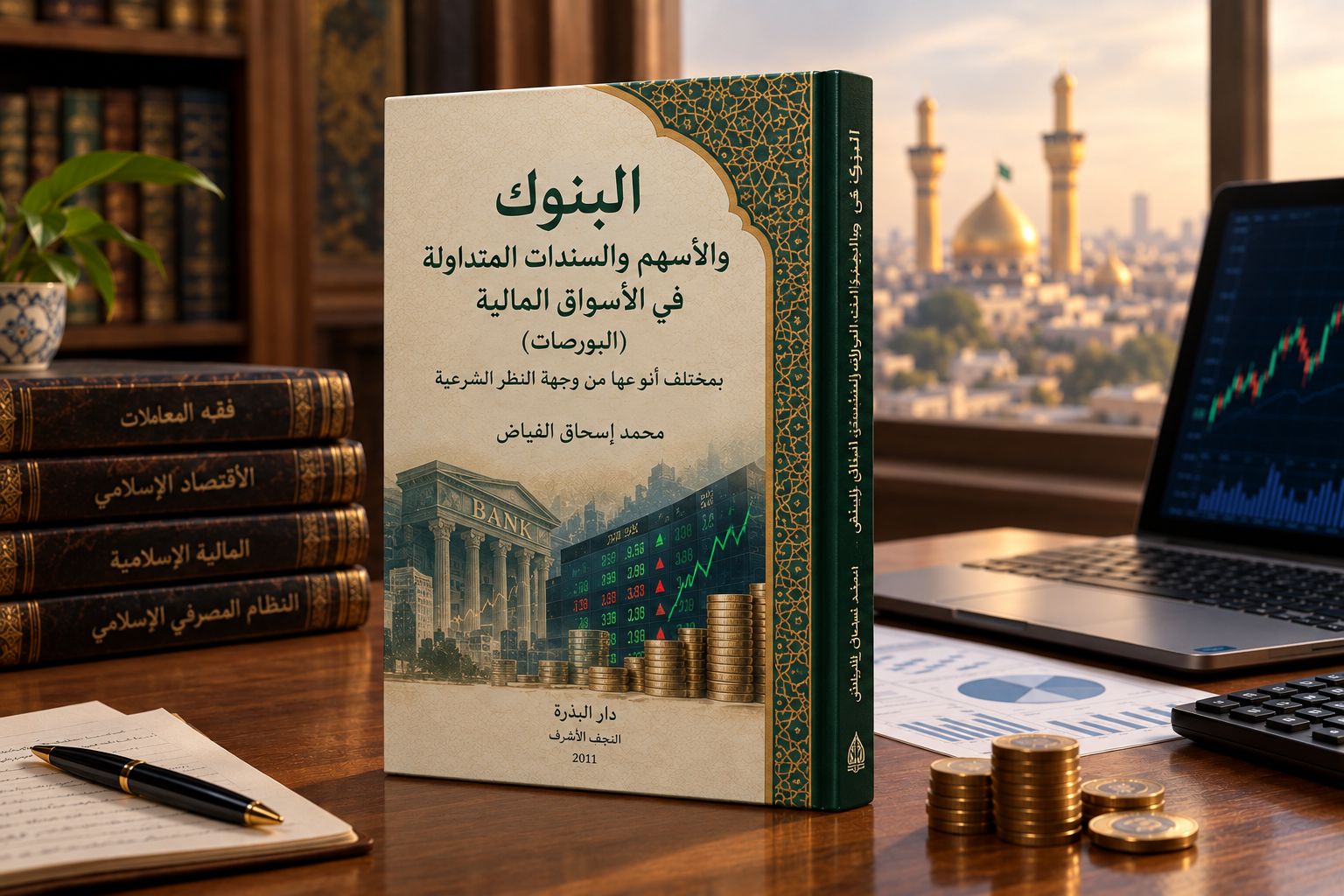
This book is particularly useful for scholars and graduate students of Islamic jurisprudence, Islamic economics, Islamic finance, banking, financial law, and contemporary Shi’i studies, and may also interest researchers studying the intellectual history of the Najaf scholarly tradition and its engagement with modern economic institutions.
From an interdisciplinary perspective, Al-Bunūk is primarily a work of financial jurisprudence rather than an empirical economic study; it does not focus on questions such as financial efficiency, market stability, information asymmetry, or risk management, which remain open opportunities for further research building on the jurisprudential framework al-Fayyad provides. The work’s significance lies particularly in demonstrating that contemporary Shi’i jurisprudence can engage with financial institutions and instruments that did not exist in their present forms in the classical period, illustrating the continuing interaction between Islamic legal reasoning and changing economic realities.
Recommendation and Conclusion
Muhammad Ishaq al-Fayyad’s Al-Bunūk is an important contribution to contemporary Shi’i financial jurisprudence. Its examination of banking, deposits, banking services, credit cards, shares, bonds, financial markets, stock exchanges, options, and futures provides a broad overview of the jurisprudential questions associated with modern finance. This work is recommended to scholars, researchers, and students interested in Islamic jurisprudence, Islamic economics, Islamic finance, banking, financial law, and contemporary Shi’i studies, and is particularly valuable for readers seeking to understand the contribution of the Najaf scholarly tradition to contemporary economic and financial questions. Ultimately, the book demonstrates the continuing effort of Shi’i jurisprudence to address new financial realities while maintaining its connection to established legal principles.
AbdulKhaleq Karimi
Assistant Professor, Department of Economics and Management, Al-Mustafa University
