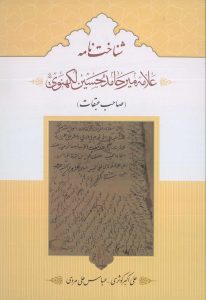
SHENĀKHT-NĀMEH-YE ʿALLĀMEH SAYYID MĪR ḤĀMID ḤUSAYN LAKHNAVĪ [A BIOGRAPHICAL COMPANION TO ʿALLĀMAH SAYYID MĪR ḤĀMID ḤUSAYN LAKHNAVĪ]. By ʿAlī-Akbar Kowtharī and ʿAbbās-ʿAlī Mardī. Qom, Iran: Nashr-e Maʿāref-e Ahl al-Bayt – Bonyād-e Beyn al-Melalī-ye Emāmat. 2022. Pp. 748. Paper. 6,000,000 IRR.
Introduction
Shenākht-nāmeh-ye ʿAllāmah Sayyid Mīr Ḥāmid Ḥusayn Lakhnavī (A Biographical Companion to ʿAllāmah Sayyid Mīr Ḥāmid Ḥusayn Lakhnavī), authored in Persian by ʿAlī-Akbar Kowtharī and ʿAbbās-ʿAlī Mardī, was published in 1401 SH/2022 CE by Nashr-e Maʿāref-e Ahl al-Bayt – Bonyād-e Beyn al-Melalī-ye Emāmat in Qom, Iran. Spanning 748 pages, the volume is an extensive documentary reference work dedicated to the life, intellectual legacy, historical context, and scholarly influence of ʿAllāmah Sayyid Mīr Ḥāmid Ḥusayn Lakhnavī (1246–1306 AH), one of the foremost Imāmī theologians of nineteenth-century India.
Unlike a conventional biography, the book functions as a comprehensive biographical companion, bringing together scattered historical documents, independent studies, bibliographical records, and previously dispersed materials concerning Mīr Ḥāmid Ḥusayn and the scholarly environment of Lucknow. Through its systematic organization, it reconstructs the intellectual world of the Lucknow Shīʿī school, a tradition that profoundly shaped later centers of Shīʿī learning, including Najaf and Qom.
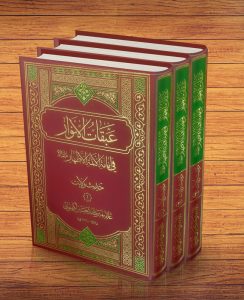
This work deserves particular attention because Mīr Ḥāmid Ḥusayn remains internationally known primarily through his monumental ʿAbaqāt al-Anwār, while his broader scholarly career, educational network, library, and historical context remain insufficiently explored. Consequently, this volume fills an important gap in contemporary Shīʿī intellectual historiography.
Summary and Content Overview
The book is organized into six major chapters, each addressing a distinct aspect of Mīr Ḥāmid Ḥusayn’s life and legacy through documentary evidence, bibliographical surveys, and historical analysis. Rather than presenting a continuous narrative biography, the authors adopt a documentary-research methodology that combines reproduced texts with extensive bibliographical inventories. This approach enables readers not only to study Mīr Ḥāmid Ḥusayn himself but also to identify the broader body of scholarship related to him.
The introductory discussions emphasize the historical importance of the Lucknow Shīʿī intellectual school. After the decline of the Isfahan theological tradition following the Safavid period, Lucknow emerged as one of the most significant centers of Imāmī scholarship in South Asia. Distinguished scholars such as Sayyid Dildār ʿAlī, Sayyid Muḥammad (Sulṭān al-ʿUlamāʾ), and Sayyid Muḥammad ʿAbbās Tustarī collectively established an intellectual tradition that strengthened Shīʿī theology during a period of intense religious controversy. Within this scholarly lineage, Mīr Ḥāmid Ḥusayn occupies a central position as a theologian whose writings defended the doctrine of Imamate while simultaneously engaging broader Islamic scholarly discourse.
The volume devotes considerable attention to Mīr Ḥāmid Ḥusayn’s educational formation. Born in Lakhnaw (Lucknow) in 1246 AH, he received his earliest education from his father before pursuing advanced studies under leading scholars of his time. The authors portray his education as exceptionally comprehensive, demonstrating how classical Islamic disciplines equipped him for later theological debates.
One of the book’s most engaging historical sections examines Mīr Ḥāmid Ḥusayn’s emergence as a public defender of Imāmī theology. The documented historical accounts recount how the publication of Muntahā al-Kalām, a polemical anti-Shīʿī work by Mawlawī Ḥaydar ʿAlī Fayḍābādī, created considerable intellectual pressure within Indian Muslim society. According to the documented accounts, Mīr Ḥāmid Ḥusayn responded by composing Istiqṣāʾ al-Ifḥām fī Naqḍ Muntahā al-Kalām within six months. The book presents this episode as a decisive turning point that established his scholarly reputation and demonstrated his remarkable mastery of Islamic textual traditions.
The authors also document his subsequent scholarly achievements, particularly his lifelong dedication to the monumental ʿAbaqāt al-Anwār fī Imāmat al-Aʾimmat al-Aṭhār. Considered one of the largest works ever written in defense of Imamate, ʿAbaqāt al-Anwār exemplifies his exhaustive documentation, extensive use of Sunnī and Shīʿī sources, and extraordinary commitment to textual verification. The volume further records his pilgrimage to Makkah and his scholarly activities in Iraq, where he continued collecting rare manuscripts and participating in learned circles before documenting these experiences in Asfār al-Anwār.
Beyond this historical narrative, the book’s principal contribution lies in its documentary organization across six thematic chapters.
The first chapter, devoted to Mīr Ḥāmid Ḥusayn’s biography, reproduces materials from 24 major sources while providing a bibliographical inventory of 91 additional works related to his life. This dual structure enables readers to distinguish between primary documentary evidence and secondary scholarship.
The second chapter focuses on his intellectual thought, presenting three substantial studies alongside references to 18 additional works that analyze his theological methodology and doctrinal contributions.
The third chapter explores his family, teachers, and students. Particularly valuable is the inclusion of four significant texts that have rarely been available in a single volume. These documents illuminate the scholarly networks through which knowledge circulated within the Lucknow school. The accompanying bibliography identifies 115 related works, making this chapter especially useful for future researchers.
The fourth chapter examines Mīr Ḥāmid Ḥusayn’s writings. In addition to four detailed documentary studies, the authors compile an impressive catalogue of 227 writings associated with him, offering one of the most comprehensive bibliographical records currently available.
The fifth chapter turns to the famous Nāṣiriyyah Library, an important intellectual heritage. Through five documentary texts and descriptions of approximately 60 related works, the authors reconstruct the formation, development, and scholarly significance of this remarkable library, illustrating its central role in preserving Islamic manuscript culture.
The sixth and final chapter investigates ʿAbd al-ʿAzīz Dihlavī’s Tuḥfat Ithnā ʿAshariyyah and the extensive body of Shīʿī refutations that followed its publication. By presenting five documentary texts together with references to 32 additional writings, the chapter situates Mīr Ḥāmid Ḥusayn’s scholarship within the broader history of Sunnī-Shīʿī theological debates in South Asia.
Throughout all six chapters, the authors consistently prioritize documentary evidence, bibliographical precision, and historical contextualization. Rather than imposing a single interpretive framework, they allow historical texts, manuscript records, and scholarly references to construct a comprehensive portrait of both the scholar and his intellectual environment.
Critical Evaluation and Significance
This volume is primarily intended for specialists in Shīʿī studies, Islamic intellectual history, South Asian Islamic scholarship, and graduate students conducting research on nineteenth-century Muslim theology. Because of its extensive documentary references and bibliographical inventories, it functions more effectively as a research companion than as an introductory biography for general readers.
Within the broader field of Islamic studies, the book occupies an important place by highlighting the often-overlooked contribution of the Lucknow school to the development of modern Imāmī scholarship. While Najaf and Qom frequently dominate contemporary discussions of Shīʿī intellectual history, this work demonstrates that Lucknow served as a crucial bridge connecting Persianate scholarship with South Asian religious thought. It thereby broadens geographical perspectives within Islamic historiography.
 The book’s greatest strengths lie in its remarkable documentation and organizational methodology. The inclusion of hundreds of bibliographical references, numerous reproduced historical texts, and carefully categorized source materials makes it an indispensable reference work. Equally significant is its success in contextualizing Mīr Ḥāmid Ḥusayn within his scholarly networks rather than portraying him as an isolated intellectual figure. This contextual approach enriches readers’ understanding of how theological traditions were transmitted, debated, and preserved across generations.
Conclusion and Recommendation
Shenākht-nāmeh-ye ʿAllāmah Mīr Ḥāmid Ḥusayn Lakhnavī is a substantial scholarly achievement that combines biography, documentary history, and bibliographical research into a single comprehensive reference work. By illuminating both the life of Mīr Ḥāmid Ḥusayn and the wider intellectual world of nineteenth-century Lucknow, it makes an important contribution to Shīʿī intellectual history and Islamic studies more broadly. The volume is highly recommended for professors, researchers, graduate students, and advanced seminary scholars interested in Imāmī theology, South Asian Islamic scholarship, and the historical development of Sunnī-Shīʿī theological debates.
