Book: Al-Āthār al-Bāqiya ʿan al-Qurūn al-Khāliya
Author: Abū Rayḥān Muḥammad b. Aḥmad al-Bīrūnī
Reviewed by: Morteza Karimi
Abū Rayḥān Muḥammad b. Aḥmad al-Bīrūnī, Al-Āthār al-Bāqiya ʿan al-Qurūn al-Khāliya (The Remaining Vestiges of Past Centuries), 1st ed., 1 vol., Tehran: Ferdows Publications, 1390 SH (2011), 560 pages.
Introduction
Al-Āthār al-Bāqiya ʿan al-Qurūn al-Khāliya (The Remaining Vestiges of Past Centuries) is one of the most significant works of the celebrated Muslim polymath Abū Rayḥān Muḥammad b. Aḥmad al-Bīrūnī (362–c. 442 AH / 973–c. 1050 CE). The book was composed around 390–391 AH (c. 1000–1001 CE), although al-Bīrūnī later revised and expanded parts of it until approximately 427 AH. The work has survived through several manuscript traditions and modern scholarly editions. One important modern edition was critically edited by ʿAzīzullāh ʿAlīzādeh and published in Tehran by Ferdows Publications in 1390 SH (2011), consisting of 560 pages. The book has also been translated into Persian by Akbar Dānāsirisht, which has helped introduce the work to a broader Persian‑reading audience.
Abū Rayḥān al-Bīrūnī is widely recognized as one of the greatest scholars of the medieval Islamic world. His intellectual contributions span numerous disciplines, including mathematics, astronomy, geography, chronology, history, philosophy, and comparative religion. Born in Khwārazm, al-Bīrūnī developed a reputation for rigorous scholarship and methodological precision. His works often combine empirical observation, mathematical reasoning, and critical evaluation of historical sources. Although he is particularly famous for scientific works such as al-Qānūn al-Masʿūdī and the ethnographic study Taḥqīq mā li’l-Hind, Al-Āthār al-Bāqiya occupies a distinctive place within his corpus because it focuses primarily on chronology and the comparative study of calendars, festivals, and historical traditions among different civilizations.
The importance of this book lies in its systematic examination of chronological systems used by various nations and religious communities. Al-Bīrūnī explores calendars, historical eras, religious festivals, and commemorative days among cultures such as the Persians, Greeks, Romans, Jews, Christians, and several other communities. Through this investigation he provides valuable information about cultural practices, religious observances, and historical traditions. The work is particularly valuable for the study of Iranian history and festivals, offering detailed descriptions of celebrations and commemorations that illuminate the intellectual and cultural life of pre‑modern societies. Because of its interdisciplinary scope and methodological sophistication, Al-Āthār al-Bāqiya remains an essential source for scholars of Islamic studies, history of science, comparative religion, and the cultural history of the ancient and medieval world.
Summary and Content Overview
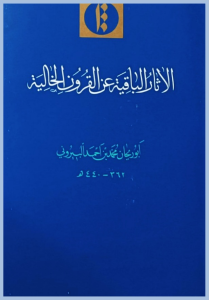 Al-Āthār al-Bāqiya is primarily a study of chronology. The book investigates how different civilizations measure time, construct calendars, and commemorate significant religious and cultural events. Al-Bīrūnī combines historical narration with astronomical and mathematical analysis, demonstrating how calendrical systems developed in relation to both astronomical observations and cultural traditions.
Structurally, the book is organized into twenty‑two discourses (aqwāl, singular qawl). Interestingly, unlike some of his other works such as al‑Qānūn al‑Masʿūdī and Taḥqīq mā li’l‑Hind, al-Bīrūnī did not explicitly number these sections in the conventional manner. Each discourse addresses particular themes related to chronology, calendars, historical eras, and religious festivals. In modern editions, the work is typically accompanied by an editorial introduction, annotations, and supplementary materials such as indices and glossaries. The modern critical edition edited by ʿAzīzullāh ʿAlīzādeh also includes several appendices, including indexes of personal names, geographical locations, sects, and books, as well as a glossary explaining difficult terms.
The central purpose of the book is to document and compare the calendrical systems of different nations. Al-Bīrūnī examines the methods used by various cultures to calculate years, months, and days. He analyzes how different civilizations determine the beginning of the year, intercalation practices, and the astronomical principles underlying their calendars. In doing so, he demonstrates a deep understanding of mathematical astronomy and highlights the relationship between scientific observation and cultural tradition.
One of the most remarkable aspects of the book is its extensive documentation of festivals and commemorative days. Al-Bīrūnī carefully records the celebrations and rituals associated with particular dates among various communities. For instance, he describes Persian festivals such as Nawrūz (the Persian New Year), explaining their historical origins, ritual practices, and cultural significance. He also records religious observances among Jews, Christians, Zoroastrians, Manichaeans, Sabians, and other groups. Through these descriptions, he provides valuable ethnographic information about the customs and beliefs of different societies.
In addition to its chronological focus, the book includes discussions of historical traditions and narratives. Al-Bīrūnī occasionally examines the histories of particular peoples and religions when such information is necessary to explain their calendrical systems or festivals. For example, he discusses aspects of Iranian, Babylonian, and Roman history in order to clarify the origins of specific eras or commemorative events. These discussions enrich the work by situating calendrical practices within broader historical and cultural contexts.
Another significant feature of the book is al-Bīrūnī’s methodological reflection on historical sources. He demonstrates an advanced critical awareness of the reliability of transmitted reports. From his discussions one can derive a classification of historical reports into several categories. First are reports that cannot be evaluated through rational analysis because they do not lend themselves to comparison with experience or observable events. Second are reports describing events that are rationally impossible or historically implausible. Third are reports concerning events that fall within what he calls al‑ʿādah al‑jāriya (the customary order of nature), which can be assessed through a combination of transmitted testimony and rational analysis.
Al-Bīrūnī emphasizes that the historian must avoid prejudice and intellectual bias. According to him, scholars should purify their minds from preconceived opinions and carefully compare different accounts in order to determine the most reliable version of an event. He also acknowledges the limitations of human knowledge. Because a human lifetime is too short to fully verify all historical reports, some traditions must be transmitted as they are so that future scholars may examine them more thoroughly.
In this sense, Al-Āthār al-Bāqiya reflects an early form of comparative cultural and religious study. Al-Bīrūnī frequently compares the beliefs and rituals of different communities, pointing out both similarities and differences. His work therefore represents one of the earliest systematic attempts within the Islamic intellectual tradition to study religions and cultures from a comparative perspective. Modern scholars often regard him as a pioneer of comparative religion and cultural anthropology.
To maintain the reader’s interest, al-Bīrūnī occasionally includes diverse and intriguing discussions that extend beyond chronology. Some of these digressions relate to natural philosophy, astronomy, and the nature of time itself. He reflects on the concept of time and the cyclical patterns of historical eras, as well as the order and harmony observable in the natural world. These reflections demonstrate his philosophical interests, which are sometimes overshadowed by his reputation as a mathematician and astronomer.
Despite his commitment to neutrality when describing the customs of different peoples, al-Bīrūnī does not entirely refrain from critical judgment. He rejects blind adherence to inherited beliefs and warns that fanaticism or prejudice can blind the intellect and prevent individuals from recognizing the truth. Consequently, when he encounters reports that contradict rational principles or the methods of scientific inquiry, he treats them with caution or skepticism.
Critical Evaluation and Significance
The primary audience for Al-Āthār al-Bāqiya includes scholars and students of Islamic studies, historians of science, researchers of chronology, and specialists in comparative religion and cultural history. Because the book brings together historical, astronomical, and ethnographic material, it is also valuable for interdisciplinary research in fields such as anthropology and the history of civilizations.
Within the broader context of Islamic intellectual history, this work occupies a distinctive and influential position. Al-Bīrūnī’s comparative analysis of calendars and religious traditions represents one of the earliest systematic studies of cross‑cultural chronology. His method combines empirical observation, mathematical calculation, and critical evaluation of historical sources. This methodological approach distinguishes his work from many earlier historical writings, which often relied heavily on uncritical transmission of reports.
One of the greatest strengths of the book lies in its intellectual openness and scholarly objectivity. Al-Bīrūnī demonstrates remarkable respect for the beliefs and traditions of other cultures while maintaining a critical analytical perspective. His comparative approach allows readers to understand how different societies conceptualize time, history, and religious observance. Furthermore, the wealth of information about Iranian festivals, ancient religions, and historical eras makes the book an invaluable resource for reconstructing aspects of pre‑modern cultural history.
In conclusion, Al-Āthār al-Bāqiya ʿan al-Qurūn al-Khāliya stands as one of the most remarkable contributions to the study of chronology and comparative cultural history in the medieval Islamic world. Through meticulous documentation and critical analysis, al-Bīrūnī provides a comprehensive account of the calendars, festivals, and historical traditions of numerous civilizations. His methodical approach, intellectual openness, and interdisciplinary perspective make the work a lasting scholarly achievement.
