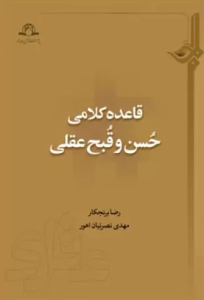
Riḍā Birinjkār and Mahdī Nuṣratiyān, Qāʿidih-yi Kalāmī-yi Ḥusn wa Qubḥ-i ʿAqlī (The Theological Principle of Rational Good and Evil), 1st ed., 1 vol., Qom: Dār al-Ḥadīth Publications, 1397 SH (2018 CE), 206 pp.
The book “Qāʿidih-yi Kalāmī-yi Ḥusn wa Qubḥ-i ʿAqlī” (The Theological Principle of Rational Good and Evil), authored by Ḥujjat al-Islām Dr. Riḍā Birinjkār and Dr. Mahdī Nuṣratiyān, is a comprehensive theological study published in Persian by the Pazhūhishgāh-i Qurʾān wa Ḥadīth (Research Institute for Qurʾān and Ḥadīth). The book explores one of the fundamental concepts in Islamic theology: the principle of rational moral judgment—al-ḥusn wa al-qubḥ al-ʿaqliyyan—an idea central to understanding divine actions in relation to human reason.
This principle underpins core theological discussions in areas such as divine justice (ʿadl), prophecy (nubuwwa), imamate (imāma), and eschatology (maʿād). The authors meticulously investigate this concept from semantic, ontological, and epistemological perspectives, highlighting its implications in both classical and contemporary kalām (Islamic theology).
Dr. Riḍā Birinjkār is a distinguished scholar and educator associated with multiple academic and religious institutions in Iran. Born in Āstārā in 1342 SH/1963 CE, he began his religious studies at the Islamic Seminary of Qom in 1361 SH/1982 CE. After completing advanced studies in Islamic jurisprudence (fiqh) and principles (uṣūl), he pursued higher education in Western philosophy, earning his BA from Shahid Beheshti University in 1369 SH/1990 CE, MA from the University of Tehran in 1375 SH/1996 CE, and PhD in 1380 SH/2001 CE.
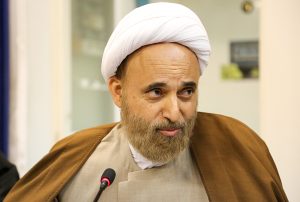
Dr. Birinjkār has taught extensively at institutions such as Farabi Campus (University of Tehran), Mofid University, and Education and Research Institute of Imam Khomeini. His areas of expertise include ancient, medieval, and modern Western philosophy, as well as Islamic philosophy and theology. His scholarly contributions encompass a wide range of topics including religious epistemology, Islamic anthropology, divine knowledge, prophecy, and more.
Dr. Mahdī Nuṣratiyān is an associate professor of Islamic jurisprudence and law at the University of Qurʾān and Ḥadīth in Ray, Iran. His academic focus lies in the methodology of theological inference, divine unity (tawḥīd), and rational moral theory. He has authored several books including Qawāʿid-i Tawḥīd, Rawish-shināsī-yi Istinbāṭ dar ʿIlm-i Kalām, and the present volume under review.
At the heart of this book lies the theological principle of ḥusn wa qubḥ-i ʿaqlī—the notion that human reason can independently discern the goodness or badness of actions, even in the absence of explicit scriptural directives. This principle, long debated among Islamic theologians, carries significant weight in the evaluation of divine justice and accountability.
According to the authors, theological principles can be divided into those that pertain to the knowledge of God and those that pertain to His actions. The principle of rational good and evil is foundational to the latter. It plays a pivotal role in understanding divine commands, moral responsibility, and human freedom, particularly within the Imāmī (Twelver Shīʿī) and Muʿtazilī schools of thought.
The authors differentiate between principles that merely describe God’s actions and those that involve value judgments. For instance, the principles of divine agency or creation ex nihilo (khalq lā min shayʾ) belong to the first category, while ḥusn wa qubḥ-i ʿaqlī involves ethical appraisal.
The book is systematically structured into five chapters, each addressing a key dimension of the principle.
- Chapter One: Introduction and Historical Overview
This chapter outlines the historical context of the debate, tracing its roots in early Islamic thought and highlighting its centrality to the development of rational theology. It categorizes theological principles and situates ḥusn wa qubḥ within the broader discourse of divine action.
- Chapter Two: Opposing Views
Here, the authors critically examine the positions of the Ashʿarīs who deny the rational discernibility of moral values. Ashʿarīs argue that moral value is derived solely from divine revelation, thereby rendering reason incapable of independent moral judgment. The authors present these views fairly but also expose their logical and theological shortcomings.
- Chapter Three: Supporting Views
This chapter discusses the affirmative stances of the Imāmiyya and the Muʿtazila, who uphold the principle of rational morality. The authors highlight their scriptural and rational arguments, emphasizing that the notion of divine justice is incoherent without presuming the intelligibility of moral values.
- Chapter Four: Preferred Position and Justifications
The authors articulate their own position, defending the rational basis for moral judgment using both philosophical reasoning and Qurʾānic exegesis. They argue that divine justice (ʿadl ilāhī) is meaningful only if humans can evaluate actions rationally. They cite verses and traditions that presuppose the moral agency of human beings and the rationality of God’s actions.
- Chapter Five: Implications for Theology
The final chapter discusses how adopting this principle affects doctrines like divine justice, accountability, prophecy, and eschatology. It shows that without rational morality, doctrines such as reward and punishment or the necessity of prophecy would be difficult to justify. The chapter also explores the broader ethical consequences of this principle for Islamic jurisprudence and theology.
 Qāʿidih-yi Kalāmī-yi Ḥusn wa Qubḥ-i ʿAqlī is a remarkable contribution to modern Islamic theology. Its academic rigor, clarity of argumentation, and methodical structure make it a valuable resource for students and scholars of kalām, Islamic philosophy, and ethics. The authors succeed in bridging classical theological debates with contemporary concerns, reaffirming the enduring relevance of rational inquiry in Islamic thought.
One of the book’s key strengths lies in its balanced and fair presentation of opposing views. Rather than merely defending a traditional Shīʿī position, the authors engage deeply with competing theological frameworks, thus demonstrating the intellectual richness of the classical kalām tradition. Their interdisciplinary approach—drawing from theology, philosophy, and textual analysis—adds further depth to their analysis.
Another noteworthy feature is the book’s pedagogical value. Initially presented as a course in the Islamic Theology Association of Qom Seminary during the 1396–1397 SH (2017-2018 CE) academic year, the content retains its instructional clarity while also offering critical insights suited for advanced research.
However, the book assumes a certain level of prior familiarity with kalām terminology and debates. Readers without a strong background in Islamic theology may find some sections conceptually dense.
In conclusion, this book is a seminal work that revives and reaffirms a foundational theological principle with contemporary relevance. It stands as an essential reference for anyone interested in Islamic moral theology, Shīʿī kalām, or the rational underpinnings of religious ethics. The authors’ efforts in combining traditional scholarship with modern analytical precision deserve wide recognition and academic engagement.
