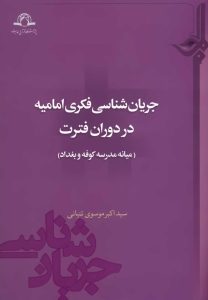
Sayyid Akbar Mūsavī Tanyānī, Jarayān-shināsī-yi Fikrī-yi Imāmiyyah dar Dowrān-i Fatrat (Miyānih-yi Madrasah-yi Kūfah va Madrasah-yi Baghdād) (The Intellectual Trend Analysis of the Imāmiyyah during the Interregnum (Between the Kūfah School and the Baghdād School)), 1st ed., 1 vol., Qom: Dār al-Ḥadīth Publications, 1398 SH (2019 CE), 478 pp.
The intellectual history of the Imāmī Shīʿī school has often been explored through the vibrant legacies of major centers like Kūfah, Qom, and Baghdād. Yet, a pivotal and somewhat obscure transitional period—the interregnum between the Kūfah and Baghdād schools—has remained relatively under-researched. In Jarayān-shināsī-yi Fikrī-yi Imāmiyyah dar Dowrān-i Fatrat (Miyānih-yi Madrasah-yi Kūfah va Madrasah-yi Baghdād) (The Intellectual Trend Analysis of the Imāmiyyah during the Interregnum (Between the Kūfah School and the Baghdād School)), Ḥujjat al-Islām Dr. Sayyid Akbar Mūsavī Tanyānī ventures into this scholarly gap. This work, a publication of his doctoral dissertation from University of Religions and Denominations, provides a critical historical and analytical framework to understand the continuity, transformation, and interaction of Imāmī intellectual movements across Baghdād, Baṣrah, and Khurāsān–Mā Warāʾ al-Nahr (Transoxania).
The book was recognized at the 38th Book of the Year of the Islamic Republic of Iran, receiving commendation for its rigorous methodology and insightful contributions to the field of Shīʿī kalām (theology).
At the heart of this study is the evolution of Imāmī kalām during a phase of intellectual and political turbulence following the decline of the Kūfah school in the late 2nd century AH (8th century CE). Dr. Mūsavī Tanyānī investigates how the Kūfan legacy was not lost but instead transferred and reconfigured in other significant regions. The emergence of new kalāmī trends, their engagement with pre-existing doctrines, and their eventual synthesis in the Baghdād school—particularly under Shaykh al-Mufīd (d. 413 AH/1022 CE)—are the focal concerns.

The author’s objective is not merely descriptive. He asks critical historical questions: Did the intellectual tradition of Kūfah truly perish after its political marginalization? Or did it flourish in new geographies? What were the dynamics of intellectual exchange among regions like Baghdād, Baṣrah, and Khurāsān, and how did these exchanges shape the eventual emergence of a systematic Imāmī kalām?
Importantly, the study exclusively focuses on Imāmī (Twelver) Shīʿī streams and deliberately excludes other Shīʿī sects such as the Kaysāniyyah, Zaydiyyah, and Ismāʿīliyyah. Nonetheless, it briefly touches on sects like the Wāqifiyyah.
The book is structured into a preface and three main chapters, each dedicated to a specific geographical and intellectual sphere:
Chapter One: The Intellectual Trend Analysis of Imāmī Thought in Baghdad This chapter examines how Baghdād emerged as a center of Imāmī kalām. It explores the migration of Kūfan scholars, their integration into the urban and political landscape of the ʿAbbāsid capital, and the birth of a rationalist kalām culminating in the work of Shaykh al-Mufīd.
Chapter Two: The Intellectual Trend Analysis of Imāmī Thought in Baṣrah
Baṣrah, a known hub of early kalām and Muʿtazilī thought, played an important mediating role. This chapter focuses on the cross-pollination of ideas between the Imāmiyyah and local schools. The chapter also touches on key figures and localized schools that provided critical support for the evolving Imāmī identity.
Chapter Three: The Intellectual Trend Analysis of Imāmī Thought in Khurāsān and Mā Warāʾ al-Nahr
In the vast and culturally diverse eastern territories of Khurāsān and Mā Warāʾ al-Nahr, Imāmī thought was transmitted via scholarly networks and patronage structures. This chapter is particularly valuable in highlighting regional adaptations of Imāmī kalām, shaped by both Persianate traditions and inter-sectarian debates. The author showcases how even in these peripheral regions, continuity with the Kūfan tradition persisted—often subtly—until it reconnected with the mainstream via Baghdād.
Dr. Mūsavī Tanyānī’s work is a scholarly book in the field of Islamic intellectual history. His approach is both methodical and innovative, avoiding the pitfalls of broad generalizations while offering a fine-grained analysis of localized intellectual trends. One of the most commendable aspects of the book is its careful source management—relying on a diverse corpus of early theological treatises, biographical dictionaries, and sectarian polemics.

By focusing strictly on Imāmī trends and excluding other Shīʿī sects, the book maintains a clear and coherent scope, though this decision might disappoint readers looking for a more pan-Shīʿī perspective. The interaction with groups like the Wāqifiyyah is a welcome inclusion and suggests how sectarian boundaries were not always rigid, allowing for mutual influence and shared intellectual heritage.
The book’s analytical depth is matched by its structural clarity. Each chapter is well-organized and draws meaningful comparisons across regions. The author’s ability to trace intellectual lineages, despite the fragmentary nature of historical sources, is particularly impressive.
 However, for non-Persian readers, the lack of an Arabic or English edition may limit its accessibility. The work would benefit from future translations to reach a broader academic audience.
Overall, this study contributes not only to Shīʿī studies but also to the broader field of Islamic intellectual history. It complements existing literature on the Kūfah and Qom schools and serves as a critical link in understanding the historical development of systematic Shīʿī theology.
Jarayān-shināsī-yi Fikrī-yi Imāmiyyah dar Dowrān-i Fatrat is a deeply researched and elegantly executed contribution to the historiography of Islamic thought. Dr. Mūsavī Tanyānī has filled a crucial gap by mapping the intellectual migration and transformation of Imāmī kalām in the formative centuries of Shīʿī theology. With its scholarly precision and focused inquiry, this book is essential reading for researchers interested in kalām, Shīʿī history, and Islamic sectarian development.
