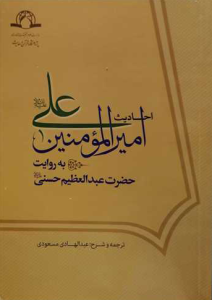
Ḥujjat al-Islām ʿAbd al-Hādī Masʿūdī, Aḥādīth-i Amīr al-Muʾminīn ʿAlī (a) bi-Riwāyat-i Ḥaḍrat-i ʿAbd al-ʿAẓīm al-Ḥasanī (The Sayings of the Commander of the Faithful ʿAlī (a) as Narrated by Ḥaḍrat ʿAbd al-ʿAẓīm al-Ḥasanī), 1st ed., 1 vol., Qom: Dār al-Ḥadīth Publications, 1402 SH (2023 CE), 270 pp.
In the rich tradition of Islamic scholarship, the sayings of Imām ʿAlī (a) stand as a pinnacle of eloquence, wisdom, and spiritual depth. They have inspired countless commentaries, translations, and scholarly reflections across centuries. The book Aḥādīth-i Amīr al-Muʾminīn ʿAlī (a) bi-Riwāyat-i Ḥaḍrat-i ʿAbd al-ʿAẓīm al-Ḥasanī (The Sayings of the Commander of the Faithful ʿAlī (a) as Narrated by Ḥaḍrat ʿAbd al-ʿAẓīm al-Ḥasanī), authored by Ḥujjat al-Islām ʿAbd al-Hādī Masʿūdī, is a valuable new contribution to this tradition. Published by Dār al-Ḥadīth in 1402 SH (2023 CE), this work offers both a refined Persian translation and a scholarly commentary on nearly one hundred narrations attributed to Imām ʿAlī (a), as transmitted through a noble and reliable chain: from Imām Muḥammad al-Jawād (a) through ʿAbd al-ʿAẓīm al-Ḥasanī (a).
The book is based on an ancient Arabic manuscript, rediscovered in the heritage archives of the Zaydī tradition in Yemen and originally dictated by Qāḍī Jaʿfar b. Aḥmad al-Yamānī (d. 573 AH). It was previously published in Arabic and later expanded into this Persian edition with commentary by Ḥujjat al-Islām Masʿūdī, under the guidance of the late Āyatullāh Muḥammadī Riyshahrī.
Ḥujjat al-Islām ʿAbd al-Hādī Masʿūdī, born in 1343 SH (1964 CE) in Qom, is a prominent scholar in Islamic studies, particularly in the field of ḥadīth. He initially pursued engineering at Sharif University but soon turned fully to seminary education. He studied under renowned scholars like Āyatullāh Jawād Tabrīzī, Āyatullāh Waḥīd Khurāsānī, and Āyatullāh Shubayrī Zanjānī. Since 1369 SH (1990 CE), he has focused seriously on ḥadīth research, including classification, translation, and commentary of Islamic traditions.

Ḥujjat al-Islām Masʿūdī is a founding member and former director of the Dar al-Ḥadīth Research Center and currently leads its Department of Ḥadīth Sciences. He also lectures at major Iranian universities including Tehran University and Sharif University. His academic work spans fiqh (jurisprudence), uṣūl (principles of jurisprudence), tafsīr (exegesis), ethics, and ḥadīth studies.
His numerous publications include Waḍ ʿ wa Naqd-i Ḥadīth, Ḥikmatnāmih-yi Adab, Rāhnamā-yi Maḥabbat, and translations of key Islamic texts. In his recent work, Aḥādīth-i Amīr al-Muʾminīn ʿAlī (a) bi-Riwāyat-i Ḥaḍrat-i ʿAbd al-ʿAẓīm al-Ḥasanī, he combines scholarly rigor with accessible commentary, making significant contributions to the preservation and understanding of Islamic heritage.
This project, in particular, is the fruit of scholarly continuity and institutional cooperation between the shrine of ʿAbd al-ʿAẓīm al-Ḥasanī in Rey and Dār al-Ḥadīth. It builds upon earlier initiatives like the publication of Musnad ʿAbd al-ʿAẓīm al-Ḥasanī, adding fresh insight and accessibility to this crucial yet understudied source of Islamic wisdom.
The central premise of the book is to provide access to a collection of narrations from Imām ʿAlī (a) that are preserved through the esteemed transmitter ʿAbd al-ʿAẓīm al-Ḥasanī (a). These narrations reflect core themes of Islamic spirituality, ethics, governance, and personal development. The commentary by Ḥujjat al-Islām Masʿūdī does not merely explain the linguistic meaning of the texts but engages the reader with their spiritual and ethical dimensions.
Underlying this endeavor is a profound recognition of ʿAbd al-ʿAẓīm al-Ḥasanī’s role as a transmitter of knowledge. ʿAbd al-ʿAẓīm al-Ḥasanī (173–252 AH), known as Shāh ʿAbd al-ʿAẓīm and Sayyid al-Karīm, was a prominent descendant of Imām al-Ḥasan al-Mujtabā (a), a revered transmitter of ḥadīth, and a close companion of the eighth and ninth Shiʿa Imāms, ʿAlī al-Riḍā (a) and Muḥammad al-Jawād (a). He later presented his beliefs to Imām ʿAlī al-Hādī (a), who endorsed his faith and praised him, a moment famously referred to as the ḥadīth of ʿArḍ al-Dīn.
His shrine, located in Ray (near modern-day Tehran), is a major pilgrimage site, with traditions equating its spiritual merit to that of visiting Imām al-Ḥusayn’s shrine in Karbalāʾ. Known for his scholarly integrity, ʿAbd al-ʿAẓīm transmitted over one hundred traditions and authored several works, including Khuṭab Amīr al-Muʾminīn and Yawm wa Laylah. His narrations have been compiled by scholars such as Shaykh al-Ṣadūq in Jāmiʿ Akhbār ʿAbd al-ʿAẓīm.
Each narration in Aḥādīth-i Amīr al-Muʾminīn ʿAlī (a) bi-Riwāyat-i Ḥaḍrat-i ʿAbd al-ʿAẓīm al-Ḥasanī is followed by a fluent Persian translation. Ḥujjat al-Islām Masʿūdī then provides contextual and thematic notes, often linking the sayings to broader Islamic teachings or parallel texts in Islamic sources.
 Masʿūdī avoids polemic or unnecessary speculation, instead grounding his explanations in Qurʾānic teachings, rational arguments, and the lived concerns of believers. His tone is inviting and reflective, suitable for both students and scholars. The Persian prose is fluent, accessible, and respectful of both the original Arabic idiom and contemporary readers’ expectations. It maintains a balance between fidelity and readability.
In sum, Aḥādīth-i Amīr al-Muʾminīn ʿAlī (a) bi-Riwāyat-i Ḥaḍrat-i ʿAbd al-ʿAẓīm al-Ḥasanī is a significant scholarly and devotional achievement. It offers a rare and intimate glimpse into the teachings of Imām ʿAlī (a) as preserved by one of the most respected figures in early Shīʿī tradition. Through its accessible commentary and reverent tone, the book serves as both a source of knowledge and a means of spiritual reflection.
Ḥujjat al-Islām Masʿūdī’s work deserves a place on the shelves of students of Islamic thought, especially those interested in Imāmology, Shīʿī ḥadīth, and the ethical teachings of the Imāms (a). It is a reminder that the words of the Imāms (a), transmitted through devoted and trustworthy narrators, remain alive, transformative, and especially pertinent to contemporary concerns.
