Overview
Since September 2025, Hujjat al-Islam Sayyid Mohsen Mortazavi has taught an Advanced Seminary Course (dars-i khārij) in Qom on the jurisprudence of artificial insemination and other methods of assisted reproduction. The course is taught in Persian on Tuesdays and Wednesdays at the Ayatollah Golpaygani Seminary School. It examines how Islamic jurisprudence (fiqh) treats methods such as in vitro fertilization, sperm and egg donation, surrogacy and the artificial womb, which the classical legal texts did not address and about which many Muslim couples and physicians now ask.
About the Course
The Subject
Artificial insemination is the use of medical techniques to achieve pregnancy without sexual intercourse. The course examines seven methods:
Why the Subject Needs a Jurisprudential Discussion
Artificial insemination, used to help couples who face infertility, is one of the new questions raised by modern medicine. The classical texts of Islamic jurisprudence did not address it, since the methods did not yet exist, so they need to be examined from the standpoint of fiqh.
Today these methods are common treatments for infertility; clinics use sperm donation, egg donation and surrogacy to help couples have children. These methods raise new jurisprudential and legal questions: the child’s lineage (nasab); who the child’s father and mother are; which relatives are regarded as unmarriageable and therefore exempt from certain modesty requirements (maḥramiyya); inheritance; and the rights of the child. Muslim couples facing infertility, and the physicians who treat them, ask which of these methods are permissible. Technology makes a treatment possible, but it does not settle whether the treatment is permissible under the shariʿa or what follows from it for the child.
Place in the Tradition
Besides whether each method is permitted (the prescriptive ruling, ḥukm taklīfī), the course examines the declaratory rulings (ḥukm waḍʿī) for the child born by these methods: whether the child’s lineage is affiliated with its biological father and mother, whether the child inherits from them and they from the child, and the child’s other rights.
Method and Evidence
For each method, the course first defines the medical procedure and its different scenarios. It then examines the Qurʾanic verses and the hadith of the Shiʿi Imams (ʿa), weighing the wording and meaning of the key terms to establish how far they bear on the question. It considers other jurists’ views and reaches a conclusion by applying the principles of jurisprudence (uṣūl al-fiqh) and legal maxims (al-qawāʿid al-fiqhiyya).
Key Questions
Positions Discussed
In the sessions held up to September 2026, Hujjat al-Islam Mortazavi has argued that methods in which the husband’s sperm fertilizes his wife’s egg are not in themselves problematic, even when the embryo is carried by a surrogate or develops in an artificial womb. Methods that use the sperm or egg of someone other than the spouse, he has argued, are problematic (fīhi ishkāl). His main evidence for this is the obligation to guard one’s chastity (ḥifẓ al-furūj) with respect to anyone other than one’s spouse.
Progress So Far
The course had reached the discussion of the artificial womb. Hujjat al-Islam Mortazavi had announced that the course would then turn to income from assisted reproduction, including charging fees for performing artificial insemination and receiving payment for providing eggs or sperm.
About Advanced Seminary Courses
The Advanced Seminary Course (dars-i khārij; baḥth al-khārij in Najaf) is the highest level of study in the Shiʿi seminaries (ḥawza). It follows the textual stage (suṭūḥ), in which students read and explain set textbooks. At the khārij level a qualified jurist (mujtahid) examines a single subject in depth, often over several years and in sessions held on most days of the week. For each question he examines the evidence from the accepted sources of Islamic jurisprudence, namely the Book (the Qurʾan), the Sunna (the words and practice of the Prophet and the Imams), reason (ʿaql) and consensus (ijmāʿ), together with the views of earlier scholars. He weighs their arguments and argues for his own conclusion by the method of ijtihād, the independent derivation of rulings from these sources. Some teachers take a classic work as the starting point of the discussion and examine the other major works and views alongside it. Students prepare for each session, review it with one another (mubāḥatha) and often write up the lectures as transcripts (taqrīrāt). The courses are usually taught in Persian in Iran and in Arabic in Iraq.
About the Instructor
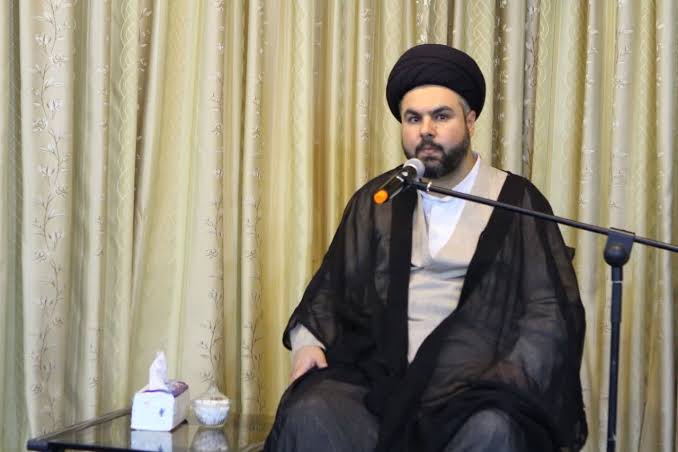
Hujjat al-Islam Sayyid Mohsen Mortazavi was born in Mashhad in April or May 1986 (Ordibehesht 1365 SH / Shaʿban or Ramadan 1406 AH). He is a grandson of Ayatollah Sayyid Hasan Mortazavi and a son of Hujjat al-Islam Sayyid Abdolhadi Mortazavi. He completed secondary school with a diploma in mathematics and was admitted to university, but chose seminary studies instead. In Mashhad, after completing the higher textual stage (suṭūḥ ʿāliya), he attended his grandfather’s Advanced Seminary Course in Jurisprudence and the Advanced Seminary Course in Principles of Jurisprudence of Ayatollah Mahdi Morvarid.
In 1389 SH (2010–2011) he moved to the seminary of Qom to continue his studies. There he studied jurisprudence with Grand Ayatollah Hossein Vahid Khorasani, Grand Ayatollah Sayyid Musa Shubayri Zanjani, Ayatollah Sayyid Mahmoud Hashemi Shahroudi, Ayatollah Mohammad Qaeni and Ayatollah Mohammad Taqi Shahidi; Qurʾanic exegesis with Grand Ayatollah Abdollah Javadi Amoli; principles of jurisprudence, jurisprudence and narrator evaluation (rijāl) with Ayatollah Hossein Shoupaei Juybari; and philosophy with Ayatollah Ali Shirvani.
Since 1389 SH he has taught at the suṭūḥ ʿāliya level in Qom, including al-Rasaʾil once, al-Makasib three times, Kifayat al-Usul twice and al-Faʾiq fi al-Usul four times. He began teaching at khārij level in 1400 SH (2021–2022). He has also taught courses in medical jurisprudence at the Qom seminary, Qom University of Medical Sciences, the Headquarters for the Promotion of Religious Rulings (Sitad-i Tarvij-i Ahkam) and Al-Mustafa International University.
Selected Works
This introduction was published by Tolou International Institute on October 30, 2026, based on the instructor’s official sources as checked on September 29, 2026. Tolou does not organize or broadcast this course. Times, venues and topics may change, and seminary courses usually pause during holidays such as the summer break and the month of Ramadan; please confirm details through the official sources. Views presented in an Advanced Seminary Course are part of a scholarly discussion and are not necessarily the instructor’s formal legal opinion (fatwa).
