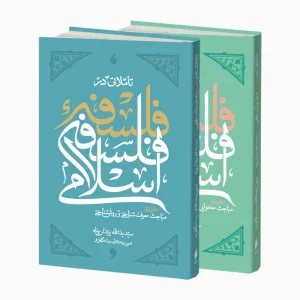
TA’AMMULĀT-Ī DAR FALSAFA-YI FALSAFA-YI ISLĀMĪ (DAFTAR-I AVVAL: MABĀḤITH-I MA’RIFAT-SHINĀKHTĪ VA RAVISH-SHINĀKHTĪ) [REFLECTIONS ON THE PHILOSOPHY OF ISLAMIC PHILOSOPHY (BOOK ONE: EPISTEMOLOGICAL AND METHODOLOGICAL DISCUSSIONS)]. By Sayyid Yadollah Yazdanpanah. Compiled and written by Reza Dargahifar. Tehran/Qom: Āl-i Aḥmad Publications / Kitāb-i Fardā, 1402 SH/2023. Pp. 368. Paper. 7,800,000 IRR.
Introduction
Second-order, or metatheoretical, studies in Islamic philosophy examine philosophy itself and the manner in which philosophical knowledge takes shape. Rather than asking merely what a given philosopher holds to be true, such studies ask how a particular theory came to be formed, on what foundation it rests, and by what method it may be evaluated. Reflections on the Philosophy of Islamic Philosophy is a work that approaches Islamic philosophy from precisely this vantage point. Authored by Sayyid Yadollah Yazdanpanah and compiled and written by Reza Dargahifar, the book’s first volume is devoted to epistemological and methodological questions.
Yazdanpanah is a contemporary scholar of Islamic philosophy and mysticism (‘irfān) who, in examining philosophical problems, employs what he calls a “historical-analytical” (tatabbu’ī-taḥlīlī) method. In this approach, each problem is first traced within its historical context, on the premise that a philosophical problem is rarely formed all at once but instead develops gradually, much like a narrative unfolding in stages. Understanding a given problem therefore requires tracing it from the very beginnings of the history of philosophy, examining the views of successive philosophers and their role in the problem’s development. Only after this stage of historical tracing (tatabbu’) does the work proceed to analysis, critique, and innovation. The present volume derives from Yazdanpanah’s advanced seminar (dars-i khārij) on Mullā Ṣadrā’s Nihāyat al-Ḥikmah and is grounded in this same method.

Overview of the Book’s Content
The first volume is organized into seven inquiries (justār), moving from foundational questions of epistemology through the methods of philosophical argumentation and the operations of reason, to conclude with the synthesis of diverse methods within transcendent philosophy (al-ḥikmah al-muta’āliyah). A notable feature of the book’s structure is that the author does not treat philosophical problems in isolation from the history of philosophy; rather, understanding each problem requires attending to the path of its formation and development.
The first inquiry examines the criterion of conceptual self-evidence (badāhat-i taṣawwurī). The discussion of self-evident conceptions matters because philosophical knowledge cannot begin without primary foundations. The author seeks to clarify the place that self-evident concepts occupy within cognition and how the mind moves from these concepts toward theoretical judgments (taṣdīqāt) and propositions. This section thus addresses one of the fundamental questions of epistemology: where does certain knowledge begin, and how can more complex forms of knowledge be built upon it?
The second inquiry is devoted to the types of demonstrative proof (burhān). Here the demonstrative method of philosophy is compared with the methods found in other sciences. The author emphasizes that each science possesses a method proper to its subject matter, and that the method of the empirical sciences cannot be extended to philosophical problems without regard for this difference in subject matter. The discussion goes on to examine demonstration of the reasoned fact (burhān-i limmī) and demonstration of the fact itself (burhān-i innī), along with the place of each within philosophical argumentation—an inquiry ultimately aimed at clarifying the criterion of argumentative validity in philosophy.
The third and fourth inquiries are devoted to the operations of theoretical reason. This section examines the role of reason in confronting ontological problems, with particular attention to “intellectual intuition” (shuhūd-i ‘aqlī) as a central theme. The author argues that intellectual intuition cannot be regarded merely as a subjective, personal experience; rather, its place and its criteria within the system of philosophical knowledge must be examined. In this way, the relationship between intuition and demonstrative reasoning is also addressed.
The concluding inquiries take up the question of “methodological synthesis” within transcendent philosophy. Mullā Ṣadrā’s philosophy draws upon several distinct sources—Peripatetic philosophy, the philosophy of illumination (ḥikmat al-ishrāq), theoretical mysticism, and revelational teachings. This raises an important question: can methods and sources that appear, on the surface, to differ substantially from one another be reconciled within a single philosophical system?
In addressing this question, the author engages with the views of Ibn Sīnā, Suhrawardī, Ibn ‘Arabī, and Mullā Ṣadrā, tracing the development of these positions over time. The book ultimately argues that Mullā Ṣadrā did not simply juxtapose a collection of disparate views but rather forged connections among these sources by redefining concepts such as existence, causality, and knowledge.
The book is thus not merely a historical report on Islamic philosophy. The author first seeks, through historical tracing, to understand a given problem within its process of formation, and then, in the mode of analysis, proceeds to examine and evaluate the various positions. It is this feature that distinguishes the book’s structure from a purely pedagogical or historical text.
Evaluation of the Work
 The book’s most significant strength lies in its “historical-analytical” method. In approaching each problem, the author does not settle for the most recently articulated position but instead traces its background back to the very origins of the history of philosophy. This approach prevents the views of philosophers from appearing as a disconnected collection of statements; instead, each theory is understood in relation to prior theories and within the historical process of the problem’s development. Such an approach is of considerable importance for a precise understanding of Islamic philosophy.
A further strength is the work’s movement beyond mere transmission and reporting. Having examined the various positions, the author proceeds to analyze them and, in a number of cases, attempts to offer a fresh formulation of the problem. Historical tracing here thus serves not merely as the collection of information but as a preliminary step toward analysis and innovation.
The book is also valuable for its attention to the connections among different philosophers. In the discussion of transcendent philosophy in particular, the author endeavors to show how diverse philosophical, mystical, and revelational elements are interwoven in Mullā Ṣadrā’s thought. This perspective helps the reader view transcendent philosophy not as a scattered assortment of theories but as the outcome of a historical and intellectual process.
The work nonetheless has certain shortcomings. First, its engagement with contemporary philosophical discussions—particularly analytic philosophy and contemporary epistemology—remains limited. Topics such as self-evidence, epistemic justification, and argumentative validity have likewise been the subject of extensive discussion in contemporary philosophy, and a comparison of Islamic philosophical positions with these discussions could have demonstrated the capacities of the book’s method in addressing contemporary problems.
In terms of audience, the book is best suited to graduate students and researchers specializing in Islamic philosophy. Readers without a preliminary grounding in Islamic philosophy will likely find some of the discussions dense and demanding. This, however, is consistent with the book’s specialized nature and cannot fairly be regarded as a serious weakness.
On the whole, the book’s principal value lies in its effort to reconstruct the “process by which philosophical thought is formed.” Rather than simply reporting what philosophers have said, the author seeks to show how and along what path these positions took shape, and then proceeds, through analysis, to their evaluation. This quality makes the book a notable contribution to the methodology of Islamic philosophy.
Conclusion
Reflections on the Philosophy of Islamic Philosophy is a valuable effort to examine the method by which knowledge is produced and evaluated within Islamic philosophy. Its most important feature is Yazdanpanah’s historical-analytical method, in which a problem is first understood within its historical context and subsequently subjected to analysis and judgment. This approach lifts the book above a mere chronicle of positions held. Notwithstanding the limited scope of its engagement with contemporary philosophy, the book stands as a useful resource for students and researchers of Islamic philosophy and provides a foundation for deeper study and discussion of philosophical method within the Islamic tradition.
Mohammad Javad Esmaeili Goli Ph.D. Researcher, Islamic Seminary of Qom, Iran
