When Silence Falls Over a Sanctuary: A Scholarly Conversation on Protecting Places of Worship
A report from a scientific session held at Tolou International Institute
An Old Joke, and an Older Wound
Immanuel Kant once wrote a slim, wry treatise called Perpetual Peace. In its opening pages he describes a tavern signboard he had seen in the Netherlands: above the painted image of a church graveyard ran the words “Eternal Peace.” The joke, of course, is that humanity only finds lasting peace in the grave. As long as we are alive, Kant seemed to suggest, conflict is the condition we live inside — not the exception to it.
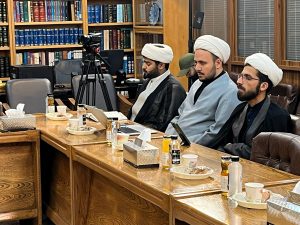
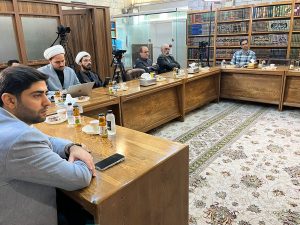
It was this image that opened a recent scientific session at Tolou International Institute, and it set exactly the right tone for what followed: a two-hour conversation, equal parts Qur’anic exegesis, jurisprudence, and international law, about one of the oldest and most fragile promises religious traditions have made to one another — that the house of worship, whoever it belongs to, should be the one place spared.
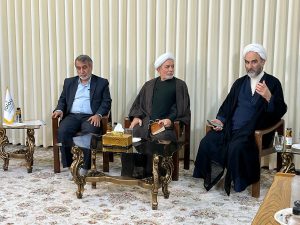
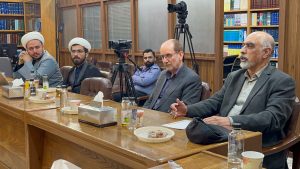
The session brought together a striking range of voices: the eminent jurist and theologian Ayatollah Mabaleghi, the international humanitarian law scholar Dr. Qasemi, and a room full of researchers, professors, and clerics who — over the course of the discussion — turned a single verse of the Qur’an into a wide-ranging meditation on theology, law, history, and what it actually means to protect a sanctuary in a century that keeps testing that promise.
Two Kinds of Law for Two Moments in War
The moderator opened by drawing a distinction that has quietly organized the laws of war for centuries: jus ad bellum, the rules that try to prevent conflict from breaking out in the first place, and jus in bello — the rules that govern conduct once it has. Sacred months in which fighting was forbidden, sanctuaries where violence could not follow you, no-fly zones and neutral territories in modern international law — all of these, he suggested, echo an old religious instinct: carve out spaces and times where the fighting simply cannot reach.
Today’s session, he explained, belonged to the second category — the law that exists inside war, whose entire purpose is to reduce human suffering once the worst has already happened. And within that body of law sits a question that has become painfully current: what happens to the mosque, the church, the synagogue, the temple, when the fighting arrives at its door?
The Verse That Wouldn’t Stay Quiet
Ayatollah Mabaleghi built his entire argument on a single Qur’anic verse — Surah al-Hajj, 22:40 — which describes what would happen “were it not that Allah checks one set of people by means of another”: monasteries, churches, synagogues, and mosques, it says, “wherein the name of Allah is much mentioned,” would have been destroyed.
He treated this, carefully, as theology rather than jurisprudence — a distinction that mattered enormously to his argument. This is not a legal ruling about what believers must do; it is a description of a divine pattern (sunnah), a recurring feature of how God has arranged human history: that a defending force will always rise up against those bent on destruction. And because it describes something structural and eternal about how the world works, rather than a one-time command, it functions the way verses like “Indeed, Allah does not change the condition of a people until they change what is in themselves” function — as a statement about how reality is built, from which legal obligations can then be drawn.
He credited the towering 20th-century exegete Allameh Tabataba’i with reviving this whole category of Qur’anic “patterns” (sunan) in his tafsir al-Mizan, a project continued by Ayatollah Beheshti and Shahid Motahhari — and noted, with evident appetite for more work still to be done, that the field remains wide open.
Confronting the Hardest Objection Head-On
But Mabaleghi didn’t stop at building the theological case — he immediately turned to dismantle its most serious challenge, framing it with real intellectual honesty before answering it.
The objection runs like this: perhaps the verse isn’t describing a timeless principle at all. Perhaps it only describes what was true for each religious community in its own era — monasteries and churches mattered in their time, and now that Christianity and Judaism have (in classical Islamic theological terms) been superseded, their sanctuaries lose the same claim on protection. If that reading holds, the argument for universal protection collapses.
Mabaleghi’s response came in layers, and it’s worth walking through because it’s genuinely elegant reasoning:
The reason given in the text won’t allow the narrowing. The verse doesn’t protect these buildings because of walls or stones — it protects them because God’s name is much mentioned there. That’s the operative cause, and a cause, once stated, cannot be selectively applied. As he put it, quoting a principle every student of usul al-fiqh will recognize: al-‘illatu tu’ammim — “the cause generalizes.” Wherever the reason for a ruling exists, the ruling follows, regardless of era or edifice.
The sequence in the verse resists the “supersession” reading. The Qur’an lists monasteries and churches before mosques — chronologically out of order if the point were to privilege the newest, “unsuperseded” faith. If this were really about ranking religions by validity, he argued, the order would have run the other way.
A sister verse confirms it’s about a permanent principle, not a historical episode. Elsewhere the Qur’an uses nearly identical language — “were it not that Allah checks people by means of others, the earth would be corrupted” (2:251) — about the prevention of corruption generally, a plainly permanent and universal principle. The verse about houses of worship, he argued, is simply one instance of that same eternal pattern.
Even the Qur’an’s praise of monks only makes sense if the monastery itself still matters. The Qur’an commends “priests and monks” for their freedom from arrogance (5:82) — and monkhood, Mabaleghi pointed out (drawing on his own travels to monasteries in Greece), is inseparable from the place. A monk in the city is not a monk; the humility the Qur’an praises is produced, in part, by the space itself.
And the great interfaith invitation only works if worship itself is valuable. “Come to a common word” (3:64) calls people of different faiths to worship together. But an invitation to worship is meaningless unless worship — and therefore the place where it happens — is itself something God finds desirable.
Taken together, he concluded, the theological ground for protecting every house of worship, of every faith, is not just permissible in principle — it is, in his words, something a jurist “should no longer hesitate over.” What is beloved to God must be preserved; what threatens ruin must be repelled. The jurisprudence, he said with something like relief, simply hasn’t caught up to build out this chapter yet.
From Theology to Treaty Law
Where Ayatollah Mabaleghi worked from scripture outward, Dr. Qasemi came at the same question from the other direction — from the accumulated architecture of international law.
He offered a sobering correction to how Muslims often frame this issue: contemporary international humanitarian law protects places of worship unconditionally — not only those belonging to Abrahamic, “People of the Book” traditions. It has no theological floor at all, because international law by its nature claims no single religious foundation. He noted, pointedly, that the destruction carried out by ISIS and similar groups across Iraq, Syria, and Afghanistan — flattening not just churches and shrines of other faiths, but shrines belonging to Muslims themselves — had no real grounding in classical Islamic jurisprudence either.
He then traced the actual legal architecture:
The foundational instrument is the 1954 Hague Convention for the Protection of Cultural Property in the Event of Armed Conflict — still, remarkably, the place where religious sites are not named independently but folded into the broader category of “cultural property.” The Convention distinguishes general protection, covering all cultural, historical, and artistic property, from special protection, reserved for sites registered as shared human heritage with UNESCO and marked with distinctive emblems.
General protection carries three core guarantees, sharpened further in Additional Protocol I of 1977 (Articles 53–54):
- Religious and cultural sites may never be a legitimate military target, under any circumstances.
- They may not be converted into military assets — a mosque basement, he noted dryly, cannot become a weapons depot.
- They may never be the target of reprisal, even after an attack — the victim state is barred from striking back at the aggressor’s own cultural or religious sites.
Special protection adds a layer of international monitoring. Dr. Qasemi cited the Citadel of Aleppo as a case where international pressure — through UNESCO, the UN Secretary-General’s office, and states acting as intermediaries — appears to have helped keep the site largely intact even while besieged.
He also gave real institutional weight to what he called, without hesitation, one of the most significant humanitarian acts of the past two decades: Iran’s “Defenders of the Shrine” mobilization in Syria and Iraq. Setting aside its sectarian framing entirely, he argued that had the assault on the shrines in Karbala and Najaf succeeded, the resulting sectarian conflagration would have destabilized the entire Islamic world for a generation. He was careful to frame this strictly as an international-law analyst’s assessment, not propaganda.
The UN Security Council, he noted, backed this architecture with two resolutions during the Iraq-Syria crisis — one on shared human heritage, another banning the antiquities trade specifically by listed terrorist organizations (al-Nusra, al-Qaeda, ISIS). Enforcement mechanisms exist too: the 1998 Rome Statute names attacks on such sites a war crime under Article 8, and Iranian domestic law prescribes up to ten years’ imprisonment for officials who order such destruction.
The Room Pushes Back — Productively
What made this session genuinely valuable was that it didn’t stay a lecture. A wide circle of scholars pressed both speakers on real tensions in the argument, and the exchanges sharpened everything.
Dr. Fazli raised a structural asymmetry worth sitting with: Islamic jurisprudence, working from the Hajj verse, tends to derive an obligation to protect the sacred sites of monotheistic religions specifically — while international human rights law defines “religion” far more broadly, covering any belief system. That gap, he suggested, deserves real scholarly attention rather than being smoothed over.
Dr. Mirdamadi, former head of Tehran’s Center for Interfaith Dialogue, posed perhaps the sharpest question of the day: shouldn’t the conversation be less about the status of religious sites and more about a coherent policy of protecting them — especially given how completely Muslim communities have lost ground, both physically and culturally, across Europe? He also raised an uncomfortable historical counterweight: the Prophet himself ordered the demolition of Masjid al-Dirar, “the Mosque of Harm” — proof that the physical structure alone has never been sacrosanct in Islamic tradition; something more than architecture has always been doing the moral work.
One scholar asked the question probably on everyone’s mind: if legal protection is genuinely unconditional, would it extend even to a religious site being used, hypothetically, as a weapons depot by an adversary? Ayatollah Mabaleghi’s answer folded back into his central thesis — that the underlying logic isn’t really about buildings at all. It’s about the remembrance of God (dhikr Allah) as a value in itself, wherever and by whomever it is practiced. He grounded this further with a striking hadith: when a Zoroastrian in Nishapur left charitable bequests for the poor, and the local judge redirected the funds to Muslim recipients only, Imam Reza (a.s.) ruled that the state treasury must compensate the Zoroastrian poor in kind — implicit recognition, Mabaleghi argued, that the charitable and religious institutions of other faiths carry real standing, not none at all.
He extended the logic further, invoking the Qur’anic injunction not to insult the idols of others “lest they insult Allah in ignorance” (6:108), and Imam Ali’s conduct at al-Mada’in, where — rather than ordering the destruction of what he found there — he prayed on the site and asked, room by room, about its former use. History and heritage, Mabaleghi argued, are themselves a wellspring of spiritual meaning; erase them, and you sever part of the very source religion draws on to cultivate the soul.
Nusayrah and the Weight of the Word “Abrogation”
A parallel thread ran through the session on the theological question of naskh — whether earlier revealed religions have truly been “abrogated” by Islam, and what that word should even be taken to mean.
Mr. Baqeri pressed the point that the Qur’an’s own vocabulary complicates the standard reading: islam, in its plain linguistic sense, means submission to God — and the Qur’an describes Abraham, and by implication the earlier prophets, as muslim in that broader sense. Perhaps, he suggested, religion is better understood as a single unfolding continuum reaching its fullest expression in the Prophet Muhammad’s message, rather than a sequence of religions that cancel one another out.
Mr. Sedaghati added a striking new textual pillar to the discussion — Surah al-Nur 24:36–37, describing “houses which Allah has ordered to be raised, in which His name is remembered” by men “whom neither commerce nor trade diverts from the remembrance of Allah.” He noted the well-known tradition in which the Prophet, asked whether a particular house belonged among those referenced, answered: “Yes — and among the finest of them.” The criterion for sanctity, once again, comes back to the same single thread: the remembrance of God, wherever it occurs.
Ayatollah Mabaleghi’s synthesis of all of this was, in a way, the intellectual heart of the session: abrogation, properly understood, is a matter between the individual and God — never a license to sever social relations, to disrespect another’s worship, or to treat another faith’s sanctuary as unworthy of protection. He pointed to Article 48 of Surah al-Ma’idah — “To each of you We have prescribed a law and a method” — addressed not to Muslims alone but to the followers of every revealed religion, framed explicitly as an invitation to compete in good works, not conflict. Citing Imam Ali’s testament to Malik al-Ashtar — “instill in your heart mercy, love, and kindness for your subjects, for they are of two kinds: either your brother in faith, or your equal in creation” — he drew out a conclusion that visibly moved the room: if that standard demands compassion even for those outside one’s own faith entirely, then the argument some in seminary circles make — that affection even for fellow Muslims of other schools is impermissible — simply cannot stand.
The Sober Reality of Enforcement
Dr. Qasemi closed the legal discussion on a notably realist note. International humanitarian law’s guarantees are strong on paper, he acknowledged, but enforcement remains fundamentally dependent on state consent — no state can be hauled before an international tribunal without its own agreement, a limitation every government, including Iran’s, has itself relied on when convenient. Real protection, in practice, runs through public diplomacy, media, and international institutions like UNESCO far more than through courtrooms.
He offered a candid, almost self-critical observation about his own country’s public messaging: Iran’s actual institutional record, he argued — its treaty commitments, its domestic legal frameworks, the fact that its own Judiciary has worked directly with Christian, Armenian, Jewish, and Zoroastrian religious leaders to let each community govern its personal-status law according to its own religious codes — is genuinely strong. The trouble, he suggested, is a gap between that careful, informed policy work happening in ministries and councils, and a more combative public rhetoric that leaves ordinary citizens uncertain whether their own state values international law at all. Promoting engagement with international law, he insisted, isn’t an optional posture — it is a strategic necessity.
Closing Thought
What lingered longest after the session wasn’t a single legal citation or Qur’anic verse — it was the throughline connecting all of them. Whether the argument moved through classical theology, comparative jurisprudence, or the architecture of the Hague and Geneva conventions, it kept arriving at the same place: a sanctuary is worth protecting not because of the stone it’s built from, but because of what happens inside it — the turning of a human heart toward God. Protect that, the room seemed to agree, and you have grounds, sacred and secular alike, to protect every roof it happens to live under.
