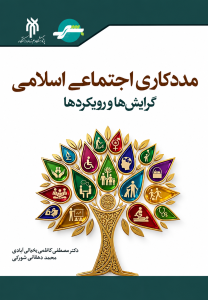
DARĀMADĪ BAR MADADKĀRĪ-YE IJTIMĀ’Ī-YE ISLĀMĪ: GIRĀYISH-HĀ VA RŪYKARD-HĀ [AN INTRODUCTION TO ISLAMIC SOCIAL WORK: TRENDS AND APPROACHES]. By Mostafa Kazemi Najafabadi and Mohammad Dehghani Shoraki. Qom, Iran: Averestan. 2025. Pp. 376. Paper. ISBN 9786223200111. 2,500,000 IRR.
Reviewed by Hossein Baqeri, PhD Student, International Institute for Islamic Studies
In contemporary academic discourse, the growing recognition that mono-dimensional, secular models of social intervention often fail to address the identity crises and structural complexities of modern life has generated renewed interest in spirituality-centered paradigms of social work. Mostafa Kazemi Najafabadi and Mohammad Dehghani Shoraki’s An Introduction to Islamic Social Work: Trends and Approaches responds directly to this need, offering what its authors present as an independent and indigenous theoretical framework for Islamic social work, grounded in the classical theory of Maqāṣid al-Sharī’ah (the Objectives of Islamic Jurisprudence). Rather than treating social work as a reactive mechanism for solving discrete social problems, Kazemi Najafabadi and Dehghani Shoraki position it as a comprehensive theory capable of contributing to global discourse on social welfare, human dignity, and holistic intervention.
The book unfolds across five interconnected chapters that move from epistemological foundations to increasingly specialized and localized discussions. The first chapter lays the epistemological groundwork, tracing the profession’s roots in divine religions and traditions of philanthropy before turning to its modern institutionalization in the West through milestones such as the codification of welfare laws, the founding of Hull House, and the publication of Mary Richmond’s Social Diagnosis. Against this backdrop, the authors position Islamic social work as a synthesis of Islamic teachings — grounded in human nature (fiṭrah) and the laws of creation — with contemporary social work principles, arguing that this synthesis strengthens both professional legitimacy and cultural authenticity.

The second and third chapters trace the historical evolution and progressive specialization of social work as a profession, surveying institutionalized subfields such as clinical, family, child, gerontological, addiction, criminal justice, school, and healthcare social work, along with emerging niche areas including environmental, rural, migrant, and crisis social work. These chapters function largely as a literature survey, situating Islamic social work within the broader disciplinary landscape rather than making a distinctively Islamic argument of their own.
The book’s central theoretical contribution appears in the fourth chapter, where Kazemi Najafabadi and Dehghani Shoraki develop a taxonomy of specializations based on the Maqāṣid al-Sharī’ah framework. They propose that a distinct specialization must possess a “categorical identity” and actively fulfill one of the objectives of Sharī’ah, and on this basis divides specializations into two categories: Principle-Based Specializations — stratified into macro-level objectives concerning the transcendental growth of the human being, meso-level objectives addressing foundational social structures such as the family and economy, and micro-level objectives tied to specific juridical rulings — and Contingent Specializations, which respond to particular temporal and spatial circumstances (such as war or natural disaster) and are navigated through the mechanisms of Ijtihād under the Wilāyat al-Faqīh. This taxonomy represents the book’s most original theoretical step and its clearest attempt to move beyond descriptive survey toward genuine theory-building.
The fifth and final chapter situates Islamic social work within the broader landscape of social work theory and practice, analyzing three dominant contemporary modalities — the individual-centered (psycho-social) approach, the social-structural (anti-oppressive) approach, and the systemic approach — before arguing that Islamic social work satisfies the scientific criteria of a complete and independent theory rather than a merely localized approach, owing to its grounding in primary religious sources, its comprehensive scope across material, psychological, and spiritual dimensions, and its systematic architecture.
 The book’s principal strength lies in its ambition and coherence: rather than presenting Islamic social work as a loose collection of religiously flavored techniques, Kazemi Najafabadi and Dehghani Shoraki construct a genuine theoretical architecture, and the Maqāṣid-based taxonomy in the fourth chapter is a valuable and underexplored contribution to the specialization literature. The five-chapter structure also gives the work useful pedagogical clarity, moving logically from historical context through professional specialization to theoretical synthesis, which should make the book accessible as a foundational text for students newly encountering the field.
The work is not without limitations, however. Its most significant weakness is the disproportion between the confidence of its theoretical claims and the relatively thin empirical or case-based support offered for them: the assertion that Islamic social work constitutes “a complete and independent theory” rests primarily on internal conceptual coherence rather than on demonstrated outcomes, field studies, or comparative practice data, and readers seeking evidence of how the Maqāṣid-based taxonomy translates into concrete intervention methods may come away without clear practical guidance. Second, chapters two and three, though useful as background, function largely as a conventional literature survey and add comparatively little that is distinctively Islamic, so that the book’s true innovation is concentrated narrowly in chapter four, leaving the middle third of the volume somewhat disconnected from its central argument. Third, despite its stated aim of contributing to “global discourse” and “cross-cultural” applicability, the book engages only lightly with the substantial existing literature on faith-based and religiously grounded social work in other traditions — such as Christian, Jewish, or Buddhist social work scholarship — a comparative engagement that would have strengthened its claims to international relevance and situated its contribution more precisely within the broader field. Finally, the breadth of the book’s ambition — spanning epistemology, professional history, specialization taxonomy, and social work theory in a single volume — occasionally comes at the expense of depth in any one area, and readers may find some sections, particularly the historical survey chapters, more compressed than the complexity of the material warrants.
Notwithstanding these limitations, An Introduction to Islamic Social Work: Trends and Approaches makes a genuine and timely contribution to the project of developing religiously grounded, indigenous theoretical frameworks in the social sciences. Its Maqāṣid-based taxonomy of specializations, in particular, deserves engagement from scholars working at the intersection of Islamic jurisprudence and the helping professions, and the book is likely to prove most valuable as a foundational text for students and researchers seeking a systematic introduction to the field, even as more empirically grounded and comparatively engaged follow-up work remains necessary to substantiate its broader theoretical claims.
