Prologue: Bridges Across Oceans
On a June evening in 2024, something quietly extraordinary happened. Across continents and time zones, scholars and seekers gathered in a virtual space where the boundaries between East and West, between Christian and Muslim, between academic discourse and lived faith began to dissolve. This was no ordinary webinar—it was a testament to what becomes possible when human beings dare to reach beyond the comfortable confines of their own traditions to touch something infinitely greater.
The event, titled “The Unity of God and the Unity in God,” would become a meditation on transcendence itself. But it began, as all profound journeys do, with simple acts of welcome and the building of bridges.
Act One: The Architecture of Hope
Doug Hostetter, a Mennonite peace pastor whose life’s work has been woven through the halls of the United Nations, opened the gathering with words that belied the revolutionary nature of what was about to unfold. This was the eighth webinar in a series that began during humanity’s darkest pandemic hours—when Luke 10, a coalition of nineteen Christian leaders from across North America and Britain, reached out to their Iranian colleagues not with politics or posturing, but with humanitarian concern and genuine friendship.
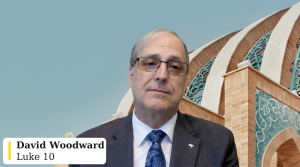 David Woodward, an international educator whose childhood memories are steeped in the dust and warmth of Tehran and Khuzestan, spoke next. His voice carried the weight of someone who understands that true dialogue is born not from theological abstractions but from the recognition that “the Iranian people inside Iran and around the world are like my own family members.” Here was a man who had crossed not just geographical borders but the more treacherous borders of the heart.
Then came Dr. Gholamreza Sedaghati of the Tolou International Institute, who told the story of a friend who, after completing advanced studies at the Qom Seminary, enrolled in an American university. “He was astounded by the unfamiliar titles in the field of Islamic studies there, just as his American peers were unfamiliar with the seminal works from Shiite seminaries.”
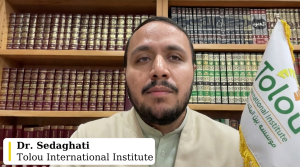 Dr. Sedaghati’s diagnosis was both precise and poignant: “This reciprocal unfamiliarity underscored a significant gap in the academic recognition of Eastern and Western scholarly works. This gap is not due to a lack of scholarship, but rather to a lack of awareness.” Here was the problem laid bare: not poverty of knowledge, but poverty of connection. The treasures existed; what was missing were the bridges.
The Tolou International Institute was founded to bridge this divide, he explained, serving “as a platform showcasing the rich body of work from academic circles in Qom, Najaf, and Mashhad,” and creating “a global forum where Muslim and Christian scholars can collaborate and share knowledge.”
The stage was set. But this would be no ordinary academic performance.
Act Two: The Mystic’s Journey
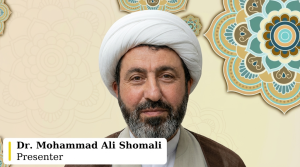
When Dr. Mohammad Ali Shomali began to speak, you could sense immediately that you were in the presence of someone for whom theology was not theory but lived experience. The Founding Director of the Risalat International Institute, editor of scholarly journals, veteran of countless interfaith dialogues—these titles fell away as he began to tell his story.
“I was not trained in inter-religious dialogue,” he confessed with disarming humility. Instead, his journey began in the seminaries of Iran, continued through Western philosophy at Tehran University, and reached a turning point in Manchester in 1996. There, pursuing a PhD on ethical relativism, he found himself seized by a hunger to understand Christianity not as a subject to be studied but as a faith to be encountered.
What followed was remarkable: friendships with Focolare movements, Anglicans, Mennonites, Benedictine monks and nuns. Ten rounds of dialogue. Six published volumes. But somewhere along this path, Shomali experienced an epiphany that would reshape his entire understanding of interfaith relations.
“Dialogue is not enough,” he declared, and you could hear both gentleness and urgency in his voice. “Dialogue is too little to describe the relation that God has made between us.”
He let this radical statement hang in the air before explaining: “Even with your enemies, you have to have dialogue. Even God has dialogue with Satan.” Dialogue, he argued, is simply the baseline of human communication. But what should exist between believers in the God of Abraham is something infinitely more profound.
The Marriage Metaphor
Then came the metaphor that would illuminate everything that followed: marriage.
“If you look at family and marriage,” Shomali explained, “a man and woman who want to get married meet several times, they talk to each other. They have honest dialogue to explore whether they suit each other for marriage. But marriage is not dialogue. You don’t marry to just have honest discussion. You marry so that you form a family. You make a unit which has now two pillars, two elements, but it’s one unit.”
In marriage, he continued, you prioritize the happiness of the other party above your own happiness. You plan together, celebrate together, grieve together. You overcome differences not by erasing them but by giving them their proper weight—refusing to let them dictate the terms of your unity.
“Unity among believers is not just dialogue,” he insisted. “Unity means that our love for God is so great that under Him we can overcome any differences.”
The Football Club Question
And then came what he called his “challenge question,” delivered with the kind of logical precision that could only come from someone equally at home in Islamic philosophy and Western analytical thought:
“If someone shares with you your language, you become very happy. If two people support the same football club, they are very happy if they meet each other. Now my question is a very fundamental question: If someone shares with you the same God, how happy should you become?”
The question hung in the virtual space like a bell that had been struck, its reverberations reaching into every corner of consciousness.
“I say my God is the Creator of the skies and the earth and all human beings. Who is your God? I’m sure you say my God is also the Creator of the sky, the earth, and all human beings. So we have the same God. Let’s be very clear: we don’t worship different gods.”
Beyond Concentric Circles
Shomali then dismantled a paradigm that has long dominated interfaith thinking—the concentric circle model where one’s co-religionists form the innermost circle, then other branches of one’s faith, then other Abrahamic faiths, expanding outward like ripples in a pond.
“I’m not saying it’s wrong,” he acknowledged, “but the real paradigm is this: the closest circle are people who are devoted to God. They may be Christians, they may be Jews, they may be Muslims. Any person who believes in the Personal God and dedicates his or her life to God is in this circle.”
The implications were stunning: “If I have a Christian friend who has dedicated his or her life to God, and I have a person from my own family for whom faith is not important—he is only thinking about money or business—which one should be closer to me? My family member who shares the same theories and doctrines but doesn’t live a godly life, or a person from another part of the world who has dedicated himself or herself to God?”
His answer was unequivocal: “If I am a servant of God, this Christian is closer to me.”
Act Three: The Franciscan’s Vision
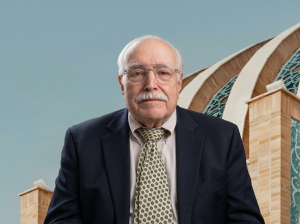
After such passionate conviction, one might have expected counterargument or defensive theology. Instead, Rev. Dr. Elias Mallon, a Franciscan Friar with nearly fifty years of Catholic-Muslim dialogue behind him, began with words that would set the tone for everything that followed: “I agree with you in everything.”
But Mallon, true to his promise, would come at the question from a profoundly different angle—one shaped by the polyglot complexity of Christian history itself.
The Geography of God-Talk
Mallon began with a concept he called “irreducible particularity”—that quality which makes each religion what it is and not something else. “Judaism is not Christianity, Christianity is not Islam,” he stated clearly. “All the dialogue in the world will not—and should not—merge, to say nothing of dissolve, these particularities.”
But then came his crucial insight: “In my personal experience, I have come to a deeper understanding of my own faith in deep encounter with other religions precisely as other. In dialogue, we learn about each other and ourselves, but we do not become each other.”
He quoted Belgian theologian Jacques Dupuis, who had suggested that Christians should stop asking “Can non-Christians be saved?” and instead ask: “What is God trying to tell us through the existence of other religious traditions?”
What followed was a masterclass in Christian history that few in the audience likely expected. Mallon painted two Christianities—not in the sense of different faiths, but different cultural and linguistic worlds that shaped how early Christians articulated their experience of God.
Western Christianity, spreading into the Hellenistic world, found itself in dialogue with polytheistic but philosophical cultures. Greek philosophical categories—substance, essence, person, nature—became the vocabulary through which Western Christians tried to express the inexpressible.
Eastern Christianity, meanwhile, remained rooted in Semitic-speaking cultures, expressing theology not primarily through philosophical propositions but through hymns, poetry, and biblical categories. While the West debated in Greek at councils, the East sang in Syriac in monasteries.
The Sun and the Summa
Mallon’s comparison of Thomas Aquinas and Ephrem the Syrian was illuminating. Aquinas, the towering Western theologian, devoted extensive sections of his Summa Theologica to the Trinity, employing rigorous logic and philosophical precision. Ephrem, the Eastern theologian-poet, approached the same mystery through the metaphor of the Sun—light, radiance, and warmth as one reality with three manifestations.
And Ephrem’s conclusion? “Accept in simplicity those three persons, receiving them with love and not questions.”
“Here I believe Christianity’s dialogue with Eastern Christians and Islam can be very helpful,” Mallon offered. “Western Christianity’s addiction to exhaustive and comprehensive legal precision can lead to a dead end.”
Allahu Akbar: The Great Relativizer
Then came what Mallon called Islam’s gift to all religious discourse: the phrase Allahu Akbar.
“Islam’s often repeated Allahu Akbar is translated often as ‘God is great’ or ‘God is the greatest.’ However, I take the word Akbar not in its superlative, but in its comparative meaning. Faced with Allahu Akbar (‘God is greater’), the question immediately arises: greater than what? Greater than everything and anything.”
This phrase, Mallon argued, is “an expression of the utter transcendence of God, a transcendence from which every human assertion about the Godhead originates and to which it is always ultimately inadequate.”
In other words: whatever we say about God—however precise our creeds, however rigorous our theology—God is always greater than our formulations. Our language points beyond itself toward a reality that will always exceed our grasp.
Act Four: The Conversation Deepens
Under the graceful moderation of Rev. Dr. Chloe Breyer, Executive Director of the Interfaith Center of New York, the two scholars began to weave their perspectives together, and the result was something approaching theological poetry.
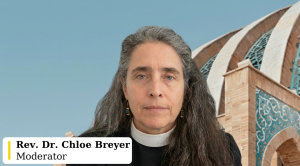
When asked about community across religious traditions, Mallon offered a perspective that reframed difference itself: “I personally find differences pedagogical and not separating. I learn from differences. It doesn’t separate me from you; it actually unites me with you in a learning experience.”
Shomali spoke of heaven—Dar al-Salam in the Quran, the Abode of Peace—as a place where unity is perfected, where the Quran promises that all sense of dislike has been removed from people’s hearts. “This is what we need to achieve also on the earth,” he explained. “The more we move towards peace and unity, the more we experience heaven.”
One of God’s names is al-Salam, he reminded them—The Peace. For believers to reflect God’s nature, they must become voices of peace at every level.
The Trinity and the Oneness
“We are certainly worshipping the same God. The Quran is very clear. The Quran invites the People of the Book to come together for the ‘Common Word.’ This shows that the Quran believes that Christians believe inthe same God. Even the Quran considers Christians to be monotheists.”
He addressed a common misconception directly: “Some people think that Christians are polytheists, and this is wrong. Christians are monotheists. They have the Trinity, but it’s a way they understand the unity of God, not that they believe in three gods.”
Mallon echoed this, returning to his central theme: “We have our understanding of the unity of the Godhead, Islam has a different one. But we have to realize that regarding all of our human assertions, God is greater.”
And then Shomali added a crucial clarification: In some hadiths, Allahu Akbar means “Allahu Akbar min an yusaf“—God is greater than any description. “Unity of God is not mathematical unity (like ‘I have one book’). Unity of God is something for which we cannot conceive of a second.”
Act Five: The Dangerous Beauty of Power
The conversation took a more challenging turn when someone asked about religious traditions becoming ruling powers—whether this helps or hinders unity.
Shomali’s answer revealed the wisdom of the mystic: “Those who have achieved inner peace and harmony and have got rid of their ego—which is not easy—if they have power, it can be useful. But unless we reach that purity inside, having power can just lead to more problems.”
He referenced Islamic mysticism’s teaching about the “Four Journeys”—spiritual stages that even prophets must complete before they can guide people. His advice: “It’s very important to go into socio-political work, but not at the beginning. When you have experience, when you have maturity, when you have worked on your spirituality, then you can go beyond.”
Mallon drew a sharp distinction: “I differentiate between politics as trying to transform society—I think people of conscience and religion are obliged to try to transform society—and the coercive power of the state. Religion should never have anything to do with the coercive power of the state. Every single time religion gets mixed with power, it’s to the disadvantage of both.”
Shomali acknowledged the tension: “Unfortunately, for the most part, you are right. In the course of history, we have many cases where power has polluted faith.” But he wouldn’t abandon the possibility entirely: “I don’t give a blank check to religious people. I say it’s a very risky path. It is necessary, but for whom? For the people who have really worked on their intention and are really at peace with themselves and with God.”
The Silent Sermon
Perhaps the most moving moment came when an academic asked how to make university students “accept basic religious articles of faith.”
Shomali’s response cut through centuries of proselytizing strategies: “As theologians, we need to be very well educated for logical explanation, but this is not the main thing. I think the main thing that attracts people to faith is your own character and your own personal witness or testimony.”
He quoted the sixth Imam, Imam Sadiq: “Call people towards faith without your tongues”—meaning through action. “Our silent preaching is very important. Our youth need to see for themselves people of real faith.”
Mallon agreed wholeheartedly: “The question is, how can we make them accept our basic religious articles of faith? I’d say: live them ourselves. The basic article of faith is ‘Love the Lord your God and your neighbor as yourself.’ If we do that, we’ll be attractive. And the fact is that when so many people who are ‘religious’ do quite the opposite, religion becomes incredibly unbelievable.”
The message was clear: the most powerful apologetic is a life lived in genuine devotion to God and love for neighbor. Arguments convince the mind; transformed lives touch the heart.
Epilogue: The Unity We Seek
As the webinar drew to a close, one sensed that something had shifted in the virtual space where these scholars and seekers had gathered. What began as a dialogue about the Unity of God had become an experience of unity among believers—not a unity that erased differences, but one that placed those differences in their proper context.
Both scholars had pointed toward the same reality from their different vantage points: God’s transcendence relativizes all our formulations, even our most cherished ones. As Mallon put it, “Allahu Akbar is one of the most important insights that Islam makes to religion in general. We have a tendency to get so caught up in our formulas and in our propositions that… well, then we get shirk [idolatry].”
The irony is profound: we can make idols of our own statements about God, mistaking our words about the Divine for the Divine itself.
Shomali had called believers to recognize that closeness to God, not theological agreement, should be the measure of spiritual kinship. Mallon had called Christians to recover the apophatic tradition—the recognition that God exceeds all our categories and concepts—and to learn from Islam’s rigorous commitment to divine transcendence.
Both had insisted that living faith, demonstrated in transformed character and genuine love, matters more than perfect propositional theology.
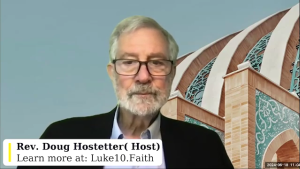 As Doug Hostetter offered his closing words, he noted that Luke 10 is “the only organization that is continuing dialogue between Iranian people and Shia Islam and the American Christian community.” But after this evening’s journey, it was clear that what Luke 10 and the Tolou International Institute were facilitating went beyond dialogue. They were creating space for unity—the kind of unity that emerges when human beings dare to love God so deeply that they recognize God’s presence in the love of others, whatever their tradition.
Coda: The Journey Continues
The webinar ended, but the questions it raised continue to reverberate:
If we truly share the same God—the Creator of heaven and earth, the God of Abraham—how should that transform our relationship with one another?
If God is always greater than our formulations, what does intellectual humility look like in our theological discourse?
If closeness to God matters more than denominational labels, how should we restructure our understanding of religious community?
If silent witness through transformed character is the most powerful form of evangelism, what does that mean for how we live our daily lives?
And perhaps most challenging of all: If unity requires us to prioritize the happiness and well-being of the other—even the religious other—above our own, what would our world look like if believers actually lived this way?
These are not comfortable questions. They challenge comfortable assumptions and demand that we look beyond the boundaries we’ve carefully constructed. But they are, ultimately, invitations to a more beautiful and more faithful way of being human before God.
The unity of God, these two scholars reminded us, is not simply a theological proposition to be believed. It is a lived reality to be embodied—a reality that, when truly grasped, transforms how we see every other person who reaches toward the divine.
In the end, perhaps that is the deepest meaning of the phrase that echoed throughout this conversation: Allahu Akbar. God is greater than our divisions. God is greater than our certainties. God is greater than our differences. And precisely because God is greater, we can find unity not despite our diversity but through our shared recognition that we all stand before Mystery itself—humbled, transformed, and joined in love.
The webinar ended. But the journey toward unity—in God and with each other—continues. And for those who participated in this extraordinary evening, the path forward has been illuminated, not by the elimination of differences, but by the recognition of a Love that transcends them all.
