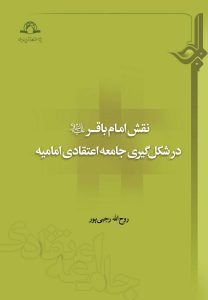
Rūḥollāh Rajabīpūr, Naqsh-i Imām Bāqir (a) dar Shikl-gīrī-yi Jāmiʿih-yi Iʿtiqādī-yi Imāmiyyah (The Role of Imām Bāqir (a) in the Formation of the Imāmī Doctrinal Community), 1st ed., 1 vol., Qom: Dār al-Ḥadīth Publications, 1400 SH (2021 CE), 327 pp.
The formative period of Shīʿī identity and thought represents one of the most critical phases in the intellectual and theological history of Islam. Among the most pivotal figures in this transformation is Imām Muḥammad al-Bāqir (a), the fifth Imām of the Ahl al-Bayt (a). The book Naqsh-i Imām Bāqir (a) dar Shikl-gīrī-yi Jāmiʿih-yi Iʿtiqādī-yi Imāmiyyah (The Role of Imām Bāqir (a) in the Formation of the Imāmī Doctrinal Community) by Rūḥollāh Rajabīpūr, offers a scholarly and evidence-based exploration into how this pivotal Imām (a) shaped a distinct doctrinal identity for the Imāmī Shīʿa in the early second century AH. Published by the Research Institute of Qurʾān and Ḥadīth, the work contributes to the field of Shīʿī theology by shedding light on the historical, social, and theological transformations orchestrated during Imām Bāqir’s era.
Rajabīpūr challenges theories that attribute the emergence of the Imāmī doctrinal community primarily to external intellectual currents or political crises. Instead, he argues—using textual and historical evidence—that the doctrinal coherence and identity of the Imāmī Shīʿa during the early second century AH were principally shaped by the deliberate teachings and strategies of Imām Bāqir (a). The book contends that prior to the Imām’s efforts, while belief in the authority of the Ahl al-Bayt (a) existed, a fully developed and distinct doctrinal community had not yet emerged.
This work asserts that it was under the guidance of Imām Bāqir (a) that the Imāmī community evolved into a structured theological entity, with clear doctrinal boundaries separating it from both other Shīʿī groups and the broader Muslim ummah. Rajabīpūr emphasizes the unique historical opportunities available in this period, such as a temporary political lull and increasing receptivity to knowledge-based religious leadership, as enabling conditions for this transformation.
The book is divided into four chapters, each addressing a distinct aspect of the emergence of the Imāmī doctrinal society.
Chapter 1: The Shīʿī Community in the Era of Imām al-Bāqir (a)
The author begins by contrasting the Shīʿī community during the time of Imām Zayn al-ʿĀbidīn (a), the fourth Imām of the Ahl al-Bayt (a), with the community under Imām Bāqir (a). While the former was marked by dispersed belief and lacked structural coherence, the latter period witnessed the emergence of a more defined and organized doctrinal identity. Rajabīpūr supports this assertion by citing historical accounts, ḥadīths, and the emergence of community symbols that reflect internal cohesion and external distinction.
Chapter 2: Social and Intellectual Capacities for Doctrinal Community-Building
This chapter explores the enabling social conditions that facilitated Imām Bāqir’s mission. Rajabīpūr examines the broader context of the Umayyad political decline, the intellectual openness of Muslim society to theological discourse, and the internal development within the early Shīʿī movement. These factors, he argues, created a rare opportunity for the Imām (a) to articulate and disseminate a structured belief system.
Chapter 3: The Pivotal Role of Imām al-Bāqir (a)
This central chapter analyzes the practical and intellectual measures taken by Imām Bāqir (a) to establish the doctrinal foundations of the Imāmī community. The author divides these efforts into two categories:
- Theoretical contributions, such as Imām Bāqir’s engagement in theological discourse, clarification of key doctrines (like Imamate, divine justice, and eschatology), and correction of deviant ideas.
- Practical actions, including the training of select disciples, encouragement of written traditions, and creation of an internal sense of identity within the community.
Through these actions, the Imām (a) was able to shape a doctrinally coherent society whose members were conscious of their distinct beliefs and confident in their collective identity.
Chapter 4: Consequences of the Formation of a Doctrinal Society
Rajabīpūr dedicates this final chapter to analyzing the aftermath of Imām Bāqir’s role in shaping the Imāmī community. He identifies three major consequences:
- Growth in Numbers: The community expanded in both population and social presence, exhibiting distinct symbols rooted in its theological outlook.
- Institutional Continuity: Upon the martyrdom of Imām Bāqir (a), the Imāmī community showed no signs of schism, instead seamlessly transitioning to the leadership of Imām al-Ṣādiq (a).
- Doctrinal Systematization: The period saw the emergence of a comprehensive theological school, effectively representing a codified kalām tradition that would influence future Shīʿī thought.
The Role of Imām Bāqir (a) in the Formation of the Imāmī Doctrinal Community stands out for its rigorous use of textual sources, its engagement with both historical and theological dimensions, and its originality in framing the Imām (a) not merely as a transmitter of knowledge, but as a community architect. One of the strengths of the book lies in its ability to synthesize dispersed historical reports into a cohesive narrative of doctrinal formation.
Rajabīpūr’s method is commendably interdisciplinary, combining ḥadīth analysis, historical chronology, and theological reflection. He does not rely on speculative reconstruction; instead, his conclusions are based on substantial references to primary sources, including narrations attributed to Imām Bāqir (a), historical chronicles, and biographical accounts of early Shīʿī scholars.
 The structure of the book is logical and accessible. Each chapter builds upon the last, and the main thesis is reiterated with increasing depth. Another commendable feature is the book’s attention to both internal identity (how Imāmīs saw themselves) and external perception (how others saw them). This dual focus gives a nuanced picture of the formation of religious identity in early Islam, a subject of increasing importance in modern Islamic studies.
In conclusion, this work is a valuable contribution to the study of early Shīʿī history and theology. It not only elevates the scholarly appreciation for Imām Bāqir’s role but also provides a model for how communities form around coherent doctrinal systems in religious history. For students of Islamic theology, historians of early Islam, and scholars of sectarian identity, Rajabīpūr’s work offers rich insights grounded in careful research.
