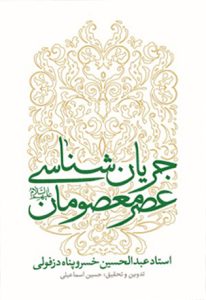
JARYĀN SHENĀSĪ ASR MA’ASŪMĀN ‘ALAYHIM AS-SALĀM. [THE STREAMOLOGY OF THE ERA OF THE INFALLIBLES (A.S)]. By Abdol Hossein Khosrowpanah. Qom, Iran: Maaref. 2024. Pp. 512. Paper. 295,000 IRR.
The field of history has always held significant importance among various Islamic movements. Islamic culture, with a focus on understanding humanity and society, presents Islam as the sole guide for individuals and the governance of society. Consequently, part of its social system is drawn from the well-reasoned and documented traditions of the Prophet and the Ahl al-Bayt (Household of the Prophet) to conduct an analysis and reform of the societal insights, values, and social behaviors that require examination. It aims to protect the sacred domain of religion from unfounded and derogatory embellishments and to purify it from the findings of human sciences and secular ideologies.
Numerous works have been produced on this topic, and what distinguishes this particular work from others is the author’s analytical, precise, and intelligent approach to the existing movements during the times of the Imams (A.S.) and their positions towards these movements.
This work consists of 18 discourses. In the first discourse, the author analyzes the period of historiography and historical writing. With the emergence and growth of historical writing during the Islamic era, attention to the factors of growth leads to further flourishing of this knowledge. The field of history has consistently been significant among various Islamic movements. In the first century of Hijra, one of the most important topics for historians and Hadith scholars was the life of the Prophet of Islam. Given the proximity of history and Hadith in Islamic sciences, many historical narratives can be found among Hadith collections, including those of Sulaym ibn Qays al-Hilali. The writing of Islamic history includes three critical phases: Sira writing (which entails the sayings and actions of the Prophet of Islam), Mathālib writing (which addresses the weaknesses and shortcomings of the opposition), and Maqtal writing (which chronicles the events of wars and the martyrdom of combatants).
Subsequently, the necessity of social movement analysis for intellectual management and cultural engineering of the country is articulated. The author then outlines characteristics for the study of movements during the era of the Infallibles, referencing the Quran: emphasizing social issues, analyzing social problems and their Quranic solutions, drawing inspiration for the formation of an Islamic government and political governance, modeling for interaction and social struggles, promoting the idea of Islamic governance, and clarifying divine traditions.
In the third discourse, the author identifies sources for movement analysis as the Quran, history, and reason. The Quran interprets history based on the prevailing traditions inherent in it, attributing the divine aspect of history to the essence of these very traditions. Thus, God does not intervene in history beyond these divine traditions, and according to the Quran, historical events are interconnected, which reflects the wisdom and good governance that God has applied to the creation of history and its scenarios. Among the key characteristics of history, according to the Quran, is its lawfulness, meaning that if no law governs history and its developments, it cannot be discovered or utilized, rendering contemplation over them futile.
In the fourth discourse, movements during the time of the Prophet Muhammad are discussed. The author refers to the movements and events during three periods of the Prophet’s life: from birth to prophethood, from prophethood to migration, and from migration to death. The Quran serves as one of the most crucial tools for analyzing the period of the Prophet, as it was revealed over 23 years, covering the most significant phases of his life. During this period, numerous events transpired for the Prophet, including the faith of new Muslims whose faith had yet to penetrate their hearts, the support of believers in battles, endurance through hardships, and confrontations with hypocrites, polytheists, and infidels. Examining the verses and the historical accounts of the Prophet’s life during his presence in Mecca as well as during the migration and his ten-year residence in Medina provides insights into the guidance methods of the Prophet and his strategies for confronting or interacting with different movements. The Prophet’s politics was intertwined with ethics, spirituality, and servitude, and his goal was to counter worldly desires, lust, oppression, and moral vices. The author suggests that a movement-oriented perspective explains the Jews of Medina’s and the Quraysh polytheists’ opposition to the Prophet as stemming from their own materialism.
In the fifth discourse, the movements during the life of Fatimah al-Zahra are highlighted. Three main movements during Fatimah’s era are identified: those believers who defended leadership (Wilayat), the group that stood against it, and the larger public that remained silent at the time of the Saqifah event and did not defend the truth. The author mentions that one of the most important reasons for the silence of some Muslims during the Saqifah was their hostility and grudge against Ali.
The sixth and seventh discourses discuss the movements during Imam Ali’s period. Generally, the Imamate of the Ahl al-Bayt over 250 years can be divided into three stages: the first stage involves safeguarding against deviation, which occurred after the Prophet’s passing, as Imam Ali sought to rectify the damages that emerged within the Islamic community over the 25 years following the Prophet’s death. The second stage began approximately with Imam Baqir (A.S.), as the Ahl al-Bayt endeavored to form a capable and distinguished group to advance the goals of Islam. The third stage concentrates on the preparations for establishing the Imamate and governance, starting from the Imamate of Imam Kazim (A.S.) and extending through to Imam Hasan al-Askari (A.S.). The period of the Alawis is one of the most significant movements during the era of the Infinites following the Prophetic era. Imam Ali’s life can also be divided into three periods: the period of Prophethood, the period of alienation (Gharbah), and the period of leadership (Wilayat). At the beginning of this period, he was the Prophet’s companion. The period of alienation refers to the post-Prophet era, which spans 25 years, encapsulated in the sermon of Shiqshiqiyyah, describing Ali’s alienation and oppression. However, this does not imply that Imam Ali was inactive; during those 25 years, he engaged in various endeavors, such as compiling the Quran, advising the caliphs, training disciples, responding to queries from Jewish and Christian scholars, and making economic efforts to address the needs of the underprivileged. The third stage of Imam Ali’s life, the era of leadership, lasted for four years and nine months, during which he confronted three fronts: the Nakithin (those who broke their pledge), the Qasitin (the oppressors), and the Marqeen (the Kharijites). Five active movements during Imam Ali’s leadership included: the movement of the companions and supporters of Imam Ali, the silent faction, the Nakithin (the pledge-breakers), the Qasitin (the oppressors), and the Marqeen (the Kharijites). The primary characteristic and focal point of the first movement was the focus on leadership. The most prominent figures among the Nakithin were Talha and Zubair, who violated their pledged allegiance to Imam Ali and instigated the Battle of Jamal. The Qasitin movement was represented by Muawiyah and the Umayyads, who opposed Imam Ali, characterized by hypocrisy and deceptive appearance. The Marqeen were the Kharijites, who opposed Imam Ali at the Battle of Nahrawan and forced arbitration upon him during the Battle of Siffin. A common trait among these movements was materialism.
The eighth discourse addresses the movements during Imam Hasan’s era. Five movements were present during this period: the Umayyad movement, the Kharijite movement, the movement of Mawali and freed slaves, the movement of worldly politicians, and the movement of pure Shi’ites. The Mawali movement consisted of a group of warriors gradually formed after the early Islamic conquests, characterized by aimlessness despite their warrior nature. Among the pure Shi’ites, some individuals were deceived by Muawiyah, betraying Imam Hasan, and ultimately, the peace with Muawiyah was imposed on Imam Hasan. In the face of this peace, Imam Hasan undertook several initiatives to clarify perceptions against Muawiyah, strengthen Muslim unity, conduct Quranic exegeses, combat social irregularities, and outline succession after Muawiyah.
In the ninth discourse, two deviant movements emerged after the peace of Imam Hasan: the ideological movement of the Kharijites and the ideological movement of the Murjiah and Jabriyyah. The Kharijite ideological movement engaged in misinterpretations of religious matters through ijtihad against the texts, while Murjiah represented an anti-rational thought within Sunni Islam, justifying the actions of oppressors.
The tenth discourse refers to the movements during Imam Husayn’s era. Of the existing movements during this era, the Ottoman and Umayyad movements were notably influential in steering society towards Ashura. This movement, headed by Muawiyah, engaged in actions such as fabricating hadith and tarnishing the image of the Ahl al-Bayt. One of the most critical aspects during this period was the role of Jews and Christians, particularly a Christian named Sergius (the advisor of Muawiyah and Yazid), in the events of Ashura. One of the factors behind the distortion of Islam in the 60 years following the Prophet was the secularization of society, with newly converted Jews managing these changes. Active movements prior to the rise of Imam Husayn included the trained Christians occupying management and governance positions, the movement against the Ansar using techniques of art, materialist scholars, and movements of Alawids and Shi’ites.
 In the eleventh discourse, the prominent movements during the era of Imam Sajjad are identified. Significant movements during this period included the Umayyads and Marwani, the movement of Ibn Zubair and the Zubayrids, and the Shi’ite movement. Among Imam Sajjad’s essential activities was providing lectures and elucidating prophetic and Islamic knowledge, combined with training distinguished disciples. Imam Sajjad conveyed Islamic laws and teachings through prayers, as significant dangers, such as the advent of diverse cultures and knowledge-based damages, were afflicting the Islamic community. Throughout this period, Imam Sajjad contended with five factions: the Ghālī (extremists), the Jabriyyah (determinists), the Mushabbihah (anthropomorphists), the Sufis, and court scholars. Important uprisings, such as the uprising of the Tawabin and the uprising of Mukhtar, occurred during this period.
In the twelfth discourse, the analysis of the movements during Imam Baqir’s era is provided. The most significant movement during this period was the presence of the Marwani in power, who caused considerable hardship for the Shi’ites and Imam. Another active movement was the Alawi and Shi’ite movement supporting the Imam. Other movements included the Kharijites, Qadariyyah, and Jabriyyah, with these last two advocating for predestination with the distinction that Jabriyyah regarded human acts as God’s creation, while Qadariyyah viewed human sins as outside of divine will. The succeeding movement involved the Ghulat, who held exaggerated beliefs about the Infallibles and entertained deification notions regarding the Imams. An important characteristic of this period was the formation of rationalist and textualist movements fostered by the companions of Imam Baqir and Imam Sadiq. The Shi’ite movement, due to severe restrictions imposed by Marwani authorities, did not hold a high social status; however, certain distinguished individuals, such as the descendants of the Prophet, enjoyed notable respect among the populace.
In the thirteenth discourse, the time of Imam Sadiq is examined. During this period, the Umayyad and Marwani dynasties faced their downfall due to factors such as injustice, anti-Islamic sentiments, and internal conflicts leading to the destruction of these regimes. Three broad categories of military uprisings took place: the first category consisted of revolts against the Marwanis, the second category involved the Abbasid revolts against the Marwanis, and the third included uprisings against the Abbasids. The movements during Imam Sadiq’s time can be divided into military and cultural categories. Cultural movements were associated with debates over theological and legal matters and the emergence of multiple sects. The Imam educated numerous disciples, viewing the most significant jihad as a cognitive and cultural warfare. Also, Zayd’s rebellion occurred during Imam Sadiq’s era; while there are no explicit reports of his stance on Zayd’s uprising, it is often interpreted that his non-participation was a form of strategy and caution. Numerous uprisings against the Umayyad and Abbasid rulers took place, attributed to various factors, including the rulers’ cruelty towards Shi’ites and the rulers’ detachment from the teachings of the Quran and the Prophet’s traditions.
In the fourteenth discourse, the movements during the era of Imam Kazim are discussed. This period encompassed five movements: the Abbasids, the Alawis, the Translation Movement, deviant ideological movements like the Zindīq (heretics) and Murjiah, and the deviant Imamite sects. The Translation Movement involved the translation of Greek medical texts, as kings sought physicians for their health, primarily from Christian and Jewish backgrounds; subsequently, other mathematical, astronomical, and theological works were translated into Arabic. Imam Kazim engaged in activities such as scholarly debates and discussions with court scholars while training disciples to counter the intellectual movements present at the time. Among the revolts of this period was the Fakh uprising against the Abbasids, which the Imam supported, although he did not publicly express this support.
 In the fifteenth discourse, the analysis of the movements during Imam Rida’s era is explored. Movements during Imam Rida’s time can be divided into four main categories: the Abbasid movement, intellectual and cultural movements featuring numerous sects, including the Waqifiyyah, the movement of the People of the Book, and the movement of the Shi’ites and followers of the Imam. The revival of the concept of leadership (Wilayat) represented a crucial strategy during Imam Rida’s tenure as a crown prince under Caliph Ma’mun. Imam Rida also engaged in numerous discussions and debates with leaders from Christian, Jewish, Zoroastrian, and Sabian backgrounds during this period. The era of Imam Rida stands out as one of the most critical periods in Shi’ite history, characterized by numerous uprisings from both Alawis and non-Alawis against the Abbasid regime. During this time, the Turks held substantial influence in governance, even having the power to change the caliph. A vital aspect of this period was the migration of Lady Fatimah Masoumah and her brothers to Iran in support of Imam Rida.
In the sixteenth discourse, the movements during Imam Jawad’s era are addressed. During this period, the Alawi uprisings against the Abbasid regime continued. A minority of Shi’ites found it difficult to accept Imam’s leadership due to his young age; in response, the Imam demonstrated miracles to establish his authority, despite Imam Rida having affirmed his Imamate. To counter the movements of his time, Imam Jawad held debate sessions, clarified various hadiths, responded to questions, and reinforced the network of representation. Additionally, he opposed the attribution of false virtues to the Prophet’s companions and provided responses to these fabrications.
In the seventeenth discourse, it is stated that the era of Imam Hadi is characterized by its obscurity, much like the personality of Imam Hadi himself. Various movements emerged during this era, with three main movements: the political movement of the Abbasids, theological schools such as the Hadith scholars, Ghālī, and Waqifiyyah, and the Shi’ite movement. During this time, Alawi uprisings against the Abbasids persisted. Among his most significant achievements was strengthening the Shi’ite organization throughout the Islamic realm. Furthermore, through activities such as conveying diverse narratives, engaging in debates, clarifying the issues of Imamate and Mahdiyyat, training pure companions, and encouraging visits to Imam Husayn’s grave, he critiqued contradictory ideologies.
The final discourse begins with an introduction to Imam Mahdi and the reasons for his occultation, discussing the issue of Mahdiyyat based on Quranic verses and hadiths. Throughout this period, several movements manifested, including the Abbasid movement, the movements of false Mahdists, and the Shi’ite movement (representing the network of representation and specific companions of Imam Mahdi). Ultimately, all ideological, cultural, political, and social movements during the times of the minor and major occultation are considered continuations of the movements from the era of occultation.
