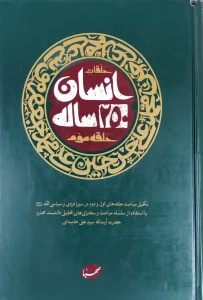
INSĀN-E 250 SĀLEH: BĀYĀNĀT MAQĀM MU’AZZAM RAHBARĪ DARBARIYI ZINDIGĪ SIYĀSĪ-MUBĀRIZĀTĪ A’IMMIH. [ A 250 YEARS OLD PERSON: STATEMENTS OF THE LEADER OF ISLAMIC REVOLUTION REGARDING THE POLITICAL AND STRUGGLES OF THE IMAMS]. By Ayatollah Seyyed Ali Khamenei. Tehran, Iran: Sahba. 2011. Pp. 460. Paper. 990,000 IRR

The lives of the Imams, despite apparent differences, represent a continuous and lengthy movement that begins in the 10th and 11th years of Hijra and continues for 250 years. The Imams, embodying a single character and unified purpose, necessitate that we analyze their lives as if they were one human being who lived for 250 years.
Numerous works have been written on this subject; however, the aspect of the political struggle that constitutes the continuous line of the Imams’ lives over these 250 years has often been overlooked amidst narratives focusing on their scholarly and spiritual dimensions.
This work is divided into 15 chapters. The first chapter analyzes the life of the Prophet Muhammad (PBUH). The significant task of the Prophet was to invite people to truth and engage in jihad for this cause. To achieve this, the Prophet wrote letters, engaged in debates, delivered speeches, led military expeditions, endured economic blockades, and faced threats. He was sent with the aim of completing moral excellences, marking the beginning of the people’s awakening. Over the course of 13 years, he cultivated believing and sincere individuals and, in the last ten years, decided to establish an Islamic community and nation. His first action in Medina was the establishment of an Islamic government and entry into the political arena. How could justice and equity be implemented without a government and a strong organizational structure? The Prophet’s goal in migrating to Medina was to combat the unjust, corrupt political, economic, and social environment prevalent at the time globally. The system built by the Prophet has distinctive characteristics: faith and spirituality, justice and equity, knowledge and awareness, sincerity and brotherhood, moral integrity and behavior, authority and dignity, as well as work, movement, and progress. Upon entering Medina, the Prophet entered the home of the poorest individual in the city, thereby signaling his social stance. He personally constructed a mosque on the land surrounding that house, and the first task after building the mosque was to create unity among the people of Medina, who were not all Muslims and included adherents of other divine religions like Judaism and Christianity. The next step was to foster brotherhood among the tribes. After establishing the government, the Prophet focused on safeguarding this system against enemies and its completion and development. The incident of Ghadir Khumm is a significant and decisive event in Islamic history. During this event, alongside the Quran, the Prophet introduced to the people an example of a complete human being, indicating the direction that Islamic education should take. The event of Ghadir reflects the comprehensiveness of Islam and its foresight, aiming to guide the Islamic community.
The second chapter addresses the issue of Imamate. Imamate represents the pinnacle of the desirable meaning of governing society against various management styles that stem from human weaknesses, greed, and desires. In the Shiite school of thought, an Imam and the political leader of the Islamic community must be divinely appointed and introduced by the Prophet; they must be a source of intellectual leadership and a pure, infallible interpreter of the Quran, free from any defect or flaw. In the specific understanding within Shiism, Imamate encompasses not only political and social leadership but also intellectual and ethical leadership. The Shiites believe in the succession of Imam Ali and then to the infallible Imams of his lineage. The stream of Imamate goes through four significant periods: the first period, which spans 25 years following the Prophet’s death and is characterized by silence or the Imam’s cooperation with political powers; the second period, the ascendance of the Imam during Ali’s caliphate and the brief caliphate of Hassan; the third period spans 20 years from the peace of Imam Hassan to the martyrdom of Imam Hussein, representing a brief constructive effort to establish an Islamic government that ultimately failed; and the fourth period commences after Imam Hussein’s martyrdom, extending over two centuries. The most significant element that has not been appropriately acknowledged in the lives of the Imams is their intense political struggle. Beginning in the second half of the first century, the Imams initiated their political struggle with the primary goal of establishing an Islamic system based on Imamate. Throughout the 140-year period between the tragedy of Ashura and the appointment of Imam Reza as successor, Shiites were considered dangerous adversaries to the caliphate, leading to numerous uprisings against the regime during that time.
The third chapter outlines the life history of Imam Ali. The author asserts that without figures such as Imam Ali throughout the history of humanity, values such as rights, justice, and humanity would not exist today. Following the Prophet’s prophethood and his passing, Imam Ali faced the most challenging period of his life. During the 25 years of the caliphate of the successors, Imam Ali did not remain silent; he actively introduced himself as a minister in crucial social issues, demonstrating his selflessness. Despite his anger towards the position he held, he defended and supported the caliphs against the threats from adversaries, asserting that as long as Muslim affairs were conducted correctly, and injustice did not prevail, he would remain compliant. Even during the siege and murder of Uthman, he supported the caliph, and when a group murdered him, Imam Ali expressed his outrage. Following this incident, almost all Muslims, aside from those from Sham, pledged allegiance to him. In the implementation of justice within his government and commands, Imam Ali did not show favoritism or leniency, which ultimately led to three civil wars against him, and this very justice contributed to his martyrdom. Three significant features characterized Imam Ali’s life: authority in executing justice and confronting oppression, victimization (both after the Prophet’s passing and even posthumously due to the Kharijites), and perseverance against all of life’s adversities. One key difference between Imam Ali’s government and that of the Prophet was the clear delineation of the forces of faith and disbelief during the Prophet’s time, while during Imam Ali’s era, these lines were blurred, as reputable individuals were found on opposing sides, complicating the identification of truth for the people.
 Chapter four analyzes the life of Fatima al-Zahra. She accompanied the Prophet during numerous periods, supporting him and providing solace, particularly during the events of Ash-Shi’b, when the Prophet lost his wife Khadijah and Abu Talib within a week. The spiritual status of Fatima far surpassed her revolutionary and social roles, to the extent that angels would converse with her, establishing her as a paragon for Muslim women. The life of Fatima al-Zahra encompasses three dimensions: familial responsibilities and the role of a wife, her political stance supporting the Imamate, and her devotional aspect.
The fifth chapter examines the life of Imam Hassan, focusing on the significant event of peace with Muawiya. The author suggests that had Imam Ali or Imam Hussein been in Imam Hassan’s position, they would have also sought peace with Muawiya during that sensitive moment. This peace represented the most magnificent act of heroic flexibility, as during this period, Islam transitioned from governance to a movement, preventing its deterioration into a monarchy. Within the Umayyad caliphate, groveling towards the caliphs took precedence over the qualifications of individuals, as lineage mattered significantly. Had Imam Hassan’s peace not occurred, the authentic Islamic movement would have been obliterated since ultimately, Muawiya would have prevailed over the Imam, leaving nothing of Islam’s true essence. The peace of Imam Hassan was a precursor to establishing a government after Imam Hussein; however, it unfortunately went unfulfilled. In Imam Hassan’s dealings, religion was paramount, meaning that the governance should be rooted in the sacred faith, while Muawiya prioritized power, employing deceitful methods and propaganda to maintain authority. Nonetheless, the primary reason for Imam Hassan’s failure was the mingling of faith with material motivations, where materialism became a primary concern for his followers. However, despite this setback, Imam Hassan remained active, focusing on educating and establishing an authentic Islamic movement, which ultimately triumphed.
The sixth chapter analyzes the life of Imam Hussein, chronicling the intertwining of jihad against the enemy and inner struggles, with the climax manifested during the Ashura event. In the Islamic community, materialistic and elitist individuals remained silent in the face of Yazid’s corrupt government. Imam Hussein’s goal in rising against Yazid was neither to attain power nor martyrdom but rather to fulfill a divine obligation to redirect the Islamic community to the righteous path as established by the Prophet. On multiple occasions, Imam Hussein has emphasized this intent. His uprising awakened the Islamic community, resulting in various movements in support of him after his martyrdom.

Chapter seven highlights the actions of Zainab bint Ali. The value and greatness of Zainab stem from her strong stance based on divine duty at multiple junctures, particularly before and after Ashura, where she supported her brother Imam Hussein. The message of Ashura would have remained unfulfilled without Zainab’s presence; she was a revitalizer and sustainer of the epic of Ashura. The chapter also draws comparisons between Zainab and Asiya, the wife of Pharaoh, regarding their endurance of hardships and mistreatment. Asiya prayed for death to escape Pharaoh’s tortures, while Zainab accepted her hardships and suffering, saying, “O Allah, accept these trials and pains from us.” This contrast showcases Zainab’s high character, illustrating that women in Islam are not sidelined in history but are central to significant historical events. Her powerful sermons contributed to the victory of the resistance front against Yazid’s regime. The actions of Imam Zain al-Abidin, following the tragedy of Ashura, are discussed further. During the period of captivity and following Ashura, like his aunt Zainab, he participated in public addresses and preaching, particularly in Yazid’s court. Following that immense tragedy, he dedicated himself to training and reconstructing sincere forces for Islam, continuing his efforts through prayers and gentle endeavors.
Chapter eight addresses the social and political conditions following the event of Karbala. Following Ashura, a profound fear permeated the Shiite community, exacerbated by subsequent events such as the incident of Harrah and the suppression of the Tawabeen movement, creating an extraordinary climate of oppression in Medina and Kufa. However, this fear did not eradicate the Shiite organizational structure; rather, Shi’ites gradually began to establish systematic organizations. One contributing factor to this fear was the decline and weakness of people’s faith and conviction at that time, to the extent that the death of an infamous, frivolous poet in Medina elicited public mourning, with people grieving for him.
Chapter nine analyzes the life of Imam Zain al-Abidin. His era of Imamate began amidst numerous challenges as the event of Karbala delivered a severe shock to the pillars of Shi’ism, and more broadly, to the entire Islamic world. Prominent figures, such as Muhammad ibn Shahab al-Zuhri, who were among the Imam’s students, had aligned with the government. Imam Zain al-Abidin sought to revive the religion and its core tenets in society. Due to the prevailing oppression, he propagated his teachings through supplication and sermons rather than through violent means. The ultimate goal of Imam Zain al-Abidin was to establish an Islamic government, which necessitated conditions such as the education and expansion of Islamic thought, familiarizing people with the legitimacy of the Ahl al-Bayt, and creating organized structures. It is essential to note that Imam’s plans were directed toward the future since there were no immediate conditions favorable for establishing a government during his time. His discourses represented a form of political struggle against the Umayyad regime. Because of the circumstances of that era and the need to preserve Shi’ism, he refrained from overtly confronting the government. However, he did firmly oppose the court scholars, to the extent that they fabricated hadiths to gain the caliph’s favor.
Chapter ten discusses the life of Imam Muhammad Baqir, which is seen as a continuation of Imam Zain al-Abidin’s life. This period was characterized by intellectual and organizational development. One of the Imam’s significant efforts during this time was combating distortions in Islamic doctrines to prepare the groundwork for establishing an Islamic government. Another aspect of his activity was the covert upbringing and organization of his students. In this period, the Imam held a hostile stance towards the government, enlightening people about the realities of governance, and this antagonistic position led to intense governmental persecution toward the end of the Imam’s life.
Chapter eleven examines the life of Imam Jafar Sadiq. The conditions during Imam Sadiq’s time were such that he contemplated rising against the Umayyad regime. He was a man of struggle, knowledge and organization. Imam Sadiq openly opposed the government and subtly navigated his resistance during the Abbasid era. When victory over the Umayyads seemed imminent for Imam Sadiq, the Abbasids, as a disruptive and opportunistic force, seized the opportunity. In the early days of Abbasid rule, circumstances were relatively tranquil for Imam Sadiq because of the rifts between the Umayyads and Abbasids, granting him an opportunity to propagate knowledge. Imam Sadiq established a strong organizational network across the Islamic community, encompassing the broadest domains of scientific and jurisprudential inquiry. His jurisprudence served as a protest against the caliphate that had been deprived of this academic insight. The existence of a covert, ideological, and political organization embodied his network across the Islamic governance system.
The subsequent chapter focuses on the life of Imam Musa Kazim, highlighting one of the most critical periods in the lives of the Imams. During this time, two of the most powerful and oppressive Abbasid caliphs reigned. One significant aspect of Imam Kazim’s life that has often been neglected is his struggle against the Abbasid government. His diligent pursuit of resistance and resorting to Taqiyya (dissimulation) were notable features of his life, to the extent that only a select group of his companions were informed about his designated successor. He lived a period of concealment and spent a considerable portion of his life imprisoned; even while incarcerated, he did not abandon his duty of guiding others.
 Chapter thirteen elucidates the life of Imam Reza, particularly focusing on the matter of his appointment as the heir apparent during Ma’mun’s caliphate. Ma’mun intended to transform Imam Reza’s appointment into a means to shift the arena of Shiite struggles into the realm of peaceful and secure political activity while legitimizing his caliphate and presenting the Imam as a state figure distanced from the populace. Imam Reza, however, expressed dissatisfaction with this position, and Ma’mun coerced him into acceptance through intimidation, leading the Imam to accept the post with the condition of non-interference in government affairs. During this time, Imam Reza ceased to observe Taqiyya, publicly asserting his claim to the Shiite Imamate; through these actions, Ma’mun was unable to achieve his objectives, ultimately leading to the Imam’s martyrdom.
The fourteenth chapter analyzes the lives of three Imams: Imam Jawad, Imam Hadi, and Imam Hasan Askari, focusing on the extensive organizational efforts for a long-term program and the occultation of the twelfth Imam during this period. It is vital to acknowledge that the Imams were continually engaged in struggles — a struggle imbued with a political spirit. By the end of Imam Hasan Askari’s tenure, the influence of the Imams and the expanse of Shiite circles had notably increased, which also rendered them more subjected to pressure and scrutiny.
In the concluding chapter, the concept of Mahdism is recognized as a shared principle among all Muslims, particularly the expectation of the savior, which is a common tenet among various faiths. The presence of the Mahdi signifies the continuity of the prophets’ divine mission. A crucial issue within Mahdism is the anticipation of relief, which mandates preparation and mobilization, ultimately leading to the establishment of a just government and the cessation of oppression. In the Mahdi’s society, God’s friends will be honored and His enemies humiliated, while the quality of human thought will be elevated. The author concludes by asserting that to draw nearer to the Mahdi, Islam must be propagated in other parts of the world, preparing the ground for His emergence, and orienting ourselves towards the implementation of Islamic laws.
